
If you are buying an air fryer in Singapore, the official check that matters is the SAFETY Mark: the Consumer Product Safety Office's list of Controlled Goods covers toasters, grills, deep fryers and similar appliances that cook with heated air or oil, which on our reading takes in air fryers, and Controlled Goods must be tested, registered and marked before they are sold. NEA's energy label page names no air fryer and the Climate Vouchers list leaves it out, so running cost comes down to wattage, minutes and how many rounds a meal takes; when it wears out, NEA says ALBA's collection drives and doorstep service do not take small household appliances. Rules as read on Thursday 26 November 2026; we recommend no brand, model or shop.
At a glance
- SAFETY Mark: air fryers fall in the Controlled Goods category for toasters, grills, deep fryers and similar appliances that use heated air or oil (our reading of the definition); each mark carries an 8-digit number you can search.
- Two marks: an appliance with a 3-pin plug needs one SAFETY Mark on the appliance and another on the plug.
- No energy label, no vouchers: NEA's energy label page names no air fryer, and air fryers are not among the 12 Climate Voucher products.
- Running cost: at the regulated tariff of 31.16 cents per kWh with GST (1 October to 31 December 2026), a 1,500 W fryer running flat out for 20 minutes costs at most about 16 cents.
- Disposal: ALBA's collection drives and doorstep service do not take small household appliances; NEA lists other bins that accept air fryers, if yours fits the slot.
Does an air fryer need a SAFETY Mark?
Yes. The Consumer Product Safety Office's list of controlled goods (last updated 23 June 2026) includes, among its medium-risk categories, "toasters, grills, roasters, hot plates, deep fryers and similar appliances" for household use "that use heated medium such as air and cooking oil for food preparation", up to 250 V. The list does not use the words "air fryer"; our reading is that an appliance cooking with heated air sits in that category, and the register is where to confirm a model. Medium-risk goods need a Certificate of Conformity from a designated test body to be registered.
The office's SAFETY Mark page (last updated 23 June 2026) says each mark's unique 8-digit number is traceable to the registrant and that it is illegal to advertise or supply Controlled Goods without one. Appliances with a 3-pin plug need two marks, one on the appliance and one on the plug.
Its consumer FAQ (last updated 18 May 2026) gives three steps: open the Register of Registered Controlled Goods at go.gov.sg/safety-mark, search the model number or the 8-digit number, and confirm the mark has not expired and matches the product in front of you. A number that does not tally can be reported through the CPSA+ site. Our SAFETY Mark guide walks through the register.
What should you check when buying one online or from overseas?
The office's page on shopping for safe products online (last updated 19 May 2026) warns that products from overseas may not meet Singapore's safety requirements and that you may have limited recourse if something goes wrong. It suggests asking the seller about the SAFETY Mark, plug and voltage, and looking for a manufacturer's warranty and a return or exchange policy.
The office's page on mains plugs (last updated 10 July 2026) recommends the 13 A three-pin Type G plug for most appliances, says appliances with metal bodies should be earthed through its earth pin, and warns that German-market Schuko plugs are unsuitable: their round pins stress socket contacts, leading to poor contact and overheating, and their side earthing strips cannot reach a local socket's earth contact. Our reading: an air fryer shipped with a two-pin European plug and a travel adaptor is the set-up to avoid. For the tax on an import, see our guide to GST on overseas online purchases.
Has any air fryer been recalled in Singapore?
None appeared in the copy we could read of the office's electrical safety alerts and recalls page, taken on 26 October 2026 and then last updated 29 September 2026; we could not open today's page, so a newer notice may have been added since. In that copy the recall list, January 2019 to June 2026, includes chargers, power banks, irons, a blender and a rice cooker power cord replacement, but no air fryer, toaster or oven; older recalls sit on a page we did not open. Search the exact model before you pay and, as the FAQ suggests, register it with its maker.
How much does an air fryer cost to run?
SP Group's tariff page gives the regulated tariff as 31.16 cents per kWh including GST (28.59 cents before GST) from 1 October to 31 December 2026, revised every quarter. Retailer plans differ; see our Q4 2026 tariff guide.
The arithmetic is kilowatts times hours. The rated power on the fryer's label is the most it can draw; once hot, the heater cycles on and off, so real use is usually lower (our general reading, not a measured figure). No label tells you more: NEA's energy label page (last updated 1 July 2026) asks shoppers to look for labels on air-conditioners, refrigerators, clothes dryers, televisions and lamps, and names no air fryer.
Worked example: small fryer, big fryer or the oven?
Illustrative only: the appliances, prices, power ratings and cooking times are invented, and the arithmetic is ours. Each figure assumes full rated power for the whole time, so it is a ceiling, at 31.16 cents per kWh including GST. A household cooks a family-sized batch four times a week, 208 sessions a year.
- Oven, 2,400 W: 10 minutes' preheat plus 25 minutes' cooking: 2.4 x 35/60 = 1.4 kWh, 43.62 cents a session, S$90.74 a year.
- Small air fryer A, 1,500 W, S$89: the batch needs two 20-minute rounds: 1.5 x 40/60 = 1.0 kWh, 31.16 cents a session, S$64.81 a year.
- Larger air fryer B, 1,800 W, S$159: one 20-minute round: 1.8 x 20/60 = 0.6 kWh, 18.70 cents a session, S$38.89 a year.
B draws more power per minute but finishes in one round, so it costs about S$26 a year less than A, and its extra S$70 is earned back in about 2.7 years. For one or two people, where A's single round (0.5 kWh, 15.58 cents) is enough, the bigger machine saves nothing. Either fryer beats the oven on these invented numbers; what decides it is rounds per meal, not the wattage on the box.
What safety habits do the agencies suggest?
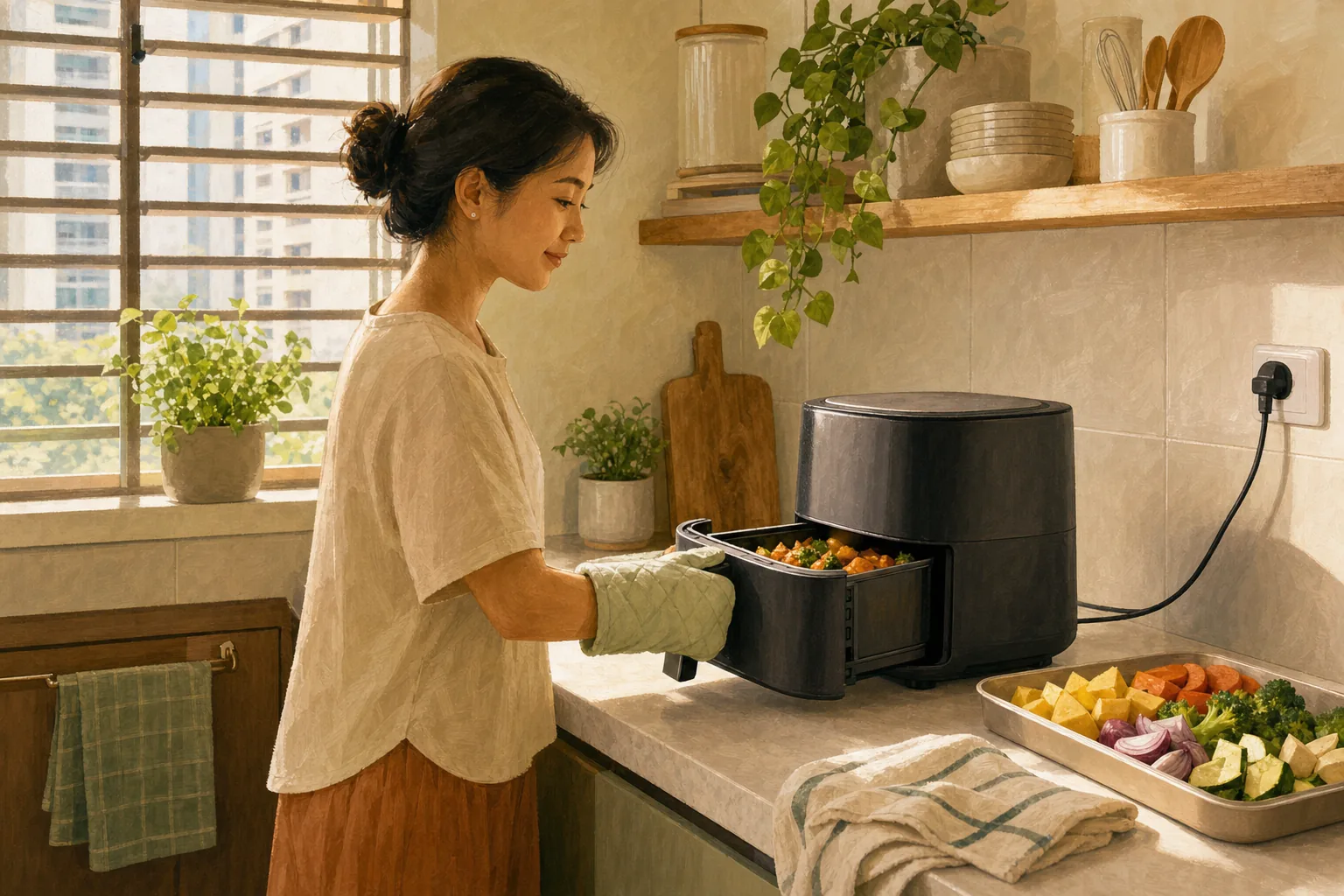
The office's tips on electrical hazards at home (last updated 21 May 2026) say to follow the manual, switch off before unplugging, pull the plug rather than the cord, stop using anything with a frayed cord, avoid overloading wall sockets, keep liquids away and have a suspected fault inspected by qualified personnel. The SCDF's fire safety at home poster adds switching appliances off when not in use and not leaving cooking unattended, and the checklist in its Civil Defence Emergency Handbook (10th edition) asks whether heat-generating appliances such as a toaster sit away from flammable materials. Our reading: a stable counter with clear space, away from curtains and kitchen roll, plugged into a wall socket rather than a crowded multi-plug.
What should you check before you pay?
Our suggestions, built from the pages above:
- Find both SAFETY Marks, on the appliance or packaging and on the plug; search the number in the register and check the expiry.
- Read the rating label for the wattage you will multiply by cooking time.
- Size it to one round for the batch you usually cook.
- Check the plug: a 13 A three-pin plug, no Schuko plug or adaptor.
- Search the model for recalls.
- Know the after-sales route. The FAQ says the office cannot help with refunds and points consumers to the Consumers Association of Singapore; see our Lemon Law guide.
What do you do with an old air fryer?
Not what you do with a washing machine. NEA's page on the e-waste producer responsibility system (last updated 28 September 2026) lists what ALBA, the appointed collector, takes at collection drives and by doorstep collection: ICT equipment, large appliances such as air-conditioners, dryers, refrigerators, televisions and washing machines, mobility devices, batteries and lamps.
NEA's where to recycle e-waste page (last updated 28 September 2026) says small household appliances such as rice cookers and microwave ovens are not accepted at ALBA's collection events or through its doorstep collection, and should go to the bins and collection avenues of the e-waste recyclers Metalo, KGS and Virogreen. Each of the three bin programmes it describes (Shell-Metalo, KGS, and Virogreen (Singapore) with SG E-Waste Recycle) lists "air fryer". Their slots measure 450 by 150 mm (Shell-Metalo and KGS) or 500 by 220 mm (Virogreen), bulky items must not be left outside a bin, and KGS's TakeBag programme takes any e-waste that fits a 460 by 400 mm polymailer bag, dropped at a PICK! locker. We recommend none of them over another. Our reading: measure the old fryer first, because many will not pass a 150 mm slot. Our e-waste guide covers phones and laptops.
Can Climate Vouchers pay for an air fryer?
No. The programme's eligible products page (last updated 13 July 2026) lists 12 product types, among them air-conditioners, clothes dryers, induction stoves, refrigerators and washing machines, and no air fryer. See our induction cooker guide and Climate Vouchers shortlist.
Common questions
Does an air fryer need a SAFETY Mark in Singapore?
Yes, on our reading of the Consumer Product Safety Office's list: appliances that cook with heated air or oil are Controlled Goods, and those with a 3-pin plug need one mark on the appliance and one on the plug.
How much electricity does an air fryer use?
At most its rated power times the cooking time: a 1,500 W fryer running flat out for 20 minutes uses 0.5 kWh, about 15.58 cents at the regulated tariff of 31.16 cents per kWh with GST for October to December 2026.
Is there an energy label for air fryers?
No: NEA's energy label page asks shoppers to look for labels on air-conditioners, refrigerators, clothes dryers, televisions and lamps, and names no air fryer.
Will ALBA collect my old air fryer?
No: NEA says small household appliances are not accepted at ALBA's collection events or through its doorstep collection, and lists three recyclers' bin programmes that take air fryers if the appliance fits through the slot.
Sources
- list of controlled goods consumerproductsafety.gov.sg
- SAFETY Mark page consumerproductsafety.gov.sg
- consumer FAQ consumerproductsafety.gov.sg
- shopping for safe products online consumerproductsafety.gov.sg
- page on mains plugs consumerproductsafety.gov.sg
- electrical safety alerts and recalls page consumerproductsafety.gov.sg
- tariff page spgroup.com.sg
- energy label page nea.gov.sg
- tips on electrical hazards at home consumerproductsafety.gov.sg
- fire safety at home poster scdf.gov.sg
- Civil Defence Emergency Handbook scdf.gov.sg
- page on the e-waste producer responsibility system nea.gov.sg
- where to recycle e-waste page nea.gov.sg
- eligible products page climate-friendly-households.gov.sg
Something changed or worth adding?
Send a correction or suggestion

