
E-waste recycling in Singapore has a new route for anyone holding on to an old phone because of what is on it. On 10 October 2026 Senior Minister of State Dr Janil Puthucheary announced the Secure-Recycle Programme, a nationwide trial run by ALBA, the appointed e-waste scheme operator, and its partners. You can drop off mobile phones, tablets and laptops free of charge at about 2,000 SPX collection points and Pick Locker locations, track the device, and receive a certificate once its data has been destroyed. It sits alongside the existing free routes: e-waste bins at every Community Centre, in-store collection at electronics shops and, since 2025, free doorstep collection of large household appliances.
If you have just upgraded, or are about to in the year-end sales, this guide sorts which route suits which item, what to do before a device leaves your hands, and how to deal with batteries, which can cause fires.
At a glance
- 10 October 2026: Senior Minister of State Dr Janil Puthucheary announced the Secure-Recycle trial at International E-Waste Day 2026, run by ALBA with Pick, SPX and Virogreen (MSE speech).
- What it takes: mobile phones, tablets and laptops, dropped off free at about 2,000 SPX collection points and Pick Locker locations.
- What you get: the ability to track the device and a certificate of data destruction after the recycler, Virogreen, destroys the data.
- Scale so far: annual e-waste collection rose from about 6,000 tonnes in 2021 to about 12,000 tonnes in 2025, and more than 45,000 tonnes had been collected under the scheme by the end of August 2026, Dr Puthucheary said.
- Next date: the event led up to Clean & Green Singapore 2026 Day on 21 November.
What is new about Secure-Recycle?
Free e-waste bins already exist, so the trial is aimed at a specific worry. Dr Puthucheary said many residents still have reservations about recycling e-waste because of concerns about convenience and data security, and the programme is designed to give "greater assurance": you can follow the device's recycling journey and receive a certificate of data destruction before it is processed to recover materials.
What the announcement did not say matters too. It gave no end date for the trial, no booking steps and no list of which SPX points or Pick lockers take part. We could not open ALBA's, SPX's or Pick's websites from our desk, so check the drop-off instructions there before you go, and ask whether chargers, cases or accessories are accepted with the device.
Which route suits which item?
The National Environment Agency's (NEA) where to recycle page, last updated 28 September 2026, and its e-waste scheme page set out the options:
- Phone, tablet or laptop with personal data on it: the new Secure-Recycle drop-off if you want a destruction certificate; otherwise an ALBA bin or in-store counter.
- Small ICT items (printers, power banks, modems, routers, set-top boxes, small TVs and desktop monitors): ALBA's 3-in-1 bins, which also take common household batteries and light bulbs up to 100mm in circumference, but not long fluorescent or LED tubes.
- Shop collection: retailers' in-store bins or counters are open to the public with or without a purchase, for e-waste of the same type the shop sells, NEA says.
- Large household appliances (air-conditioners, dryers, refrigerators, televisions and washing machines): ALBA's free doorstep collection, which NEA says has covered all residential premises since 1 January 2025, or a retailer's free one-for-one takeback when it delivers a new appliance of the same type.
- Small kitchen appliances such as rice cookers and microwaves: not taken at ALBA's drives or doorstep service; NEA lists other recyclers' e-waste bins for these.
- Anything bulky that will not fit a bin opening: do not leave it beside the bin; use a collection drive, ALBA's doorstep service (free for large household appliances; NEA says other doorstep collections carry a fee) or ALBA's depot at 20 Tuas Loop.
What should I do before a device leaves my hands?
Dr Puthucheary recapped the steps, and they apply whichever route you choose:
- Back up what you want to keep.
- Log out of your personal accounts.
- Remove the SIM card and any memory card or external storage.
- Perform a factory reset to remove all user-accessible records.
- Hand the device to a secure channel.
He said data-bearing devices sent through ALBA's channels are processed by licensed recyclers that securely erase or destroy the data. The Secure-Recycle certificate adds a record you can keep. If you are selling or trading the device instead, our guide to the second-hand electronics handover covers what to record with the buyer.
How do I get rid of old power banks and batteries safely?
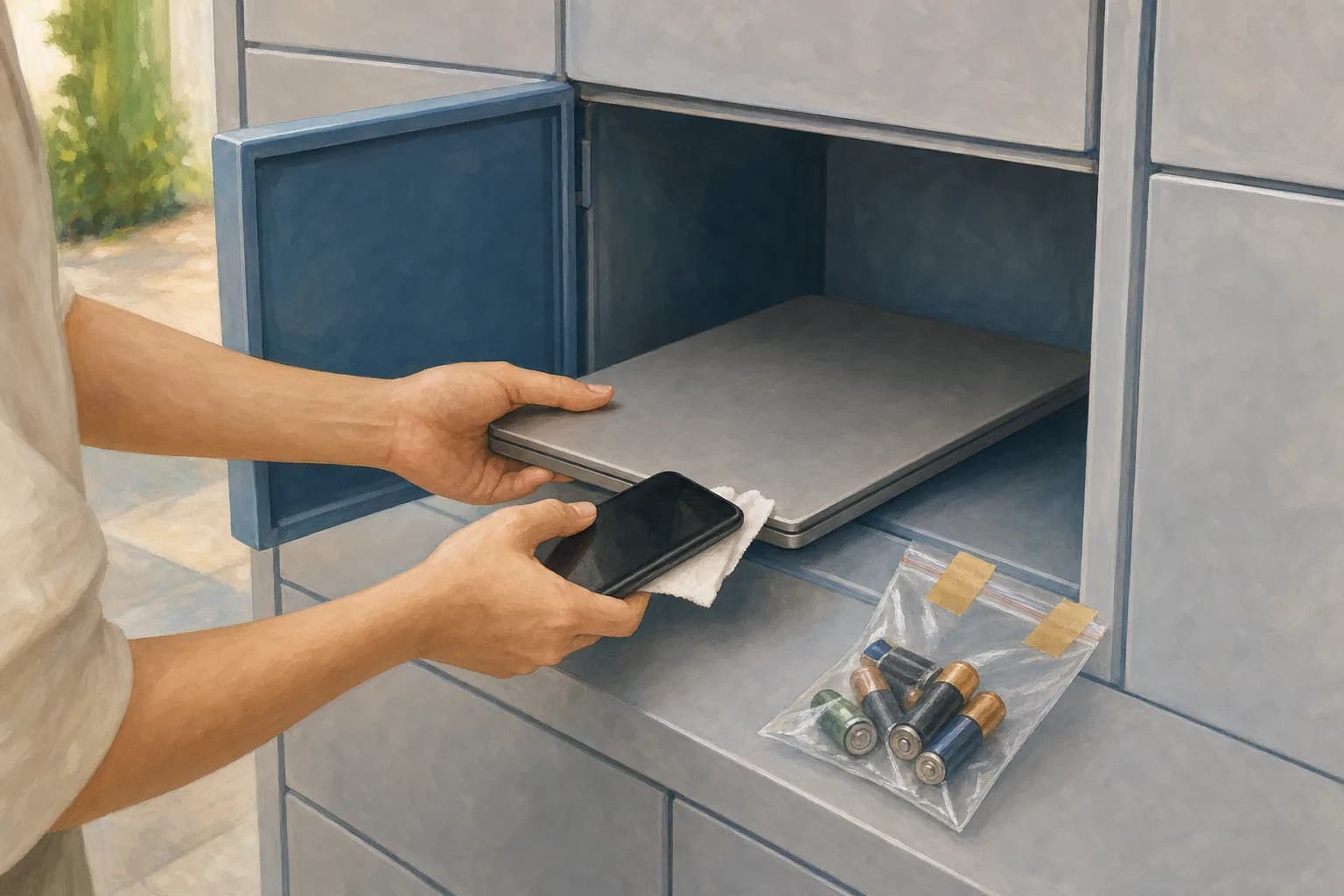
This is a safety issue, not just a recycling one. Dr Puthucheary said lithium-ion batteries in phones, laptops and power banks can cause fires if punctured, and that used batteries should never go into general waste or recycling bins, where they may be compressed, punctured or damaged during collection.
- Tape the terminals before recycling, to reduce the risk of short circuits. NEA also asks you to seal any leaking battery in a leak-proof bag.
- Use the right bin. ALBA's 3-in-1 and battery bins take AA, AAA, AAAA, C, D, 9-volt and button cells; NEA lists the size limits on its page.
- Damaged, swollen or high-capacity batteries, such as those from electric mobility devices, should be treated with extra care and handed to trained staff at ALBA's collection drives, Dr Puthucheary said.
An illustrative clear-out after an upgrade
A fictional household in Punggol replaces a phone and a laptop and buys a new refrigerator during the year-end sales. Sorted by route:
- The old phone and laptop go to the Secure-Recycle drop-off after the five steps above, and the destruction certificate is kept with the new devices' receipts.
- Two old power banks have taped terminals; one has swollen, so it goes to an ALBA collection drive instead of a bin.
- The broken rice cooker goes to an e-waste recycler's bin that accepts small appliances.
- The old fridge leaves with the delivery crew under the retailer's one-for-one takeback; if the retailer cannot take it, ALBA's free doorstep collection is the fallback.
Our ownership topic has more on what owning a device costs after the purchase, and our BCRS deposit guide covers the other new return scheme this month.
Common questions
What is the Secure-Recycle Programme?
A nationwide trial announced on 10 October 2026 in which ALBA, Pick, SPX and Virogreen let you drop off phones, tablets and laptops free at about 2,000 SPX collection points and Pick Locker locations, track them and receive a certificate of data destruction.
Can I put power banks in the blue recycling bin?
No. Batteries should never go into general waste or blue bins; tape the terminals and use an e-waste bin, or hand damaged or swollen ones to trained staff at an ALBA collection drive.
Will someone take my old fridge away for free?
NEA says retailers offer free one-for-one takeback when they deliver a new appliance of the same type, and ALBA has offered free doorstep collection of large household appliances for all residential premises since 1 January 2025.
Is a factory reset enough before recycling a phone?
Dr Puthucheary's list is to back up, log out of accounts, remove the SIM and storage cards and factory reset, then use a secure channel where licensed recyclers erase or destroy the data.
Sources
- MSE speech mse.gov.sg
- where to recycle page nea.gov.sg
- e-waste scheme page nea.gov.sg
Something changed or worth adding?
Send a correction or suggestion

