
A dehumidifier in Singapore earns its place in a room that stays damp after the weather dries, such as a musty bedroom, a store room growing mould or a flat where laundry dries indoors, not in every room. It carries no NEA energy label and is not a controlled good needing its own SAFETY Mark, so you compare watts and capacity yourself. At the regulated tariff of 31.16 cents/kWh, a 200 W unit running eight hours a night costs about S$15 over 30 nights.
Rainfall is usually higher from November to January, the Meteorological Service Singapore says, so now is the time to work out whether a damp room needs a machine, an air-con setting or better airflow.
At a glance
- 1 October to 31 December 2026: SP Group's regulated electricity tariff is 31.16 cents/kWh, or 28.59 cents/kWh before GST, according to its tariff information page.
- November to January: Singapore's higher monthly rainfall usually falls in these months, during the wet phase of the Northeast Monsoon, the Meteorological Service Singapore's climate page says.
- 16 October 2026: NEA's fortnightly outlook said Southwest Monsoon conditions would continue through late October, with below-average rainfall and warm, humid conditions on some nights.
- No energy label: NEA's mandatory labelling lists air-conditioners (portable ones since 1 April 2024), refrigerators, clothes dryers, televisions, lamps, water heaters and some commercial equipment, but not dehumidifiers, its scheme page shows.
- No SAFETY Mark of its own: dehumidifiers are not among the 33 categories of controlled goods on the Consumer Product Safety Office's (CPSO) list, last updated on 23 June 2026, though a 13-amp or 15-amp 3-pin plug is one.
- No Climate Vouchers: the vouchers, which expire on 31 December 2027, cover 12 product types and dehumidifiers are not among them, the programme's FAQ shows.
How humid does Singapore get, and when does a dehumidifier help?
Relative humidity here varies by the hour more than by the month: it is above 90% just before sunrise and falls to around 60% on afternoons without rain, the MSS climate page says. The mean is around 82%, and humidity often reaches 100% during prolonged rain.
That pattern tells you when a machine earns its keep. A room that dries out by mid-afternoon on a fine day is following the weather. One that still smells damp on a dry afternoon, or where mould keeps returning to the same corner, is holding its own moisture: that is where a dehumidifier, more airflow or a fix for the source (a leak, a blocked bathroom fan) does the work.
We found no Singapore government page setting a target humidity for homes, so treat any number a shop quotes as the seller's figure.
Dehumidifier or air-con dry mode: which should you use?
An air-conditioner already removes moisture as it cools. NEA's buying tips say air-cons control both temperature and humidity, and warn that an oversized unit "may not adequately dehumidify the space, as it cools too quickly before moisture can be reduced". If a bedroom feels cold and clammy with the air-con on, the unit's size may be the problem; our guide to air-con size for Singapore rooms has NEA's rule of thumb.
If your air-con has a dry mode, what it does varies by model, so read the manual. Three other machines are easy to confuse with a dehumidifier:
- A portable air-conditioner cools and removes moisture, and since 1 April 2024 it must carry an NEA energy label, rated from 1 to 2 ticks, the energy label page says.
- An air cooler is no fix for a damp room: the CPSO list defines it as "equipped to use water as a cooling medium".
- An air purifier with a dehumidifier does two jobs: size the purifier half as in our air purifier guide and judge the rest on the checks below.
What does a dehumidifier cost to run in Singapore?
Running cost is rated power (watts) times hours times the tariff. The wattages below are illustrative, not measurements of any model: read the rating plate or spec sheet of the unit you are considering. All use SP Group's 31.16 cents/kWh for October to December 2026.
- A 200 W unit, 8 hours a night: 1.6 kWh, about 50 cents a night, or 48 kWh and about S$14.96 over 30 nights.
- A 450 W unit, 8 hours a night: 3.6 kWh, about S$1.12 a night, or 108 kWh and about S$33.65 over 30 nights.
- An air-con whose label shows 600 kWh a year (illustrative): the label's figure assumes 8 hours' use a day plus standby, so that is about 1.64 kWh a day, roughly 51 cents a day or S$15.37 over 30 days.
The two dehumidifier figures assume the unit draws its rated power for all 8 hours; a unit with a humidity setting may cycle off once the room reaches it. Our appliance running cost calculator does the arithmetic for any wattage, and the Q4 2026 tariff guide explains the rate.
If the main job is laundry, compare the dehumidifier's monthly cost with a dryer's label cost in our clothes dryer guide. NEA's first energy saving tip for dryers is to air-dry clothes instead.
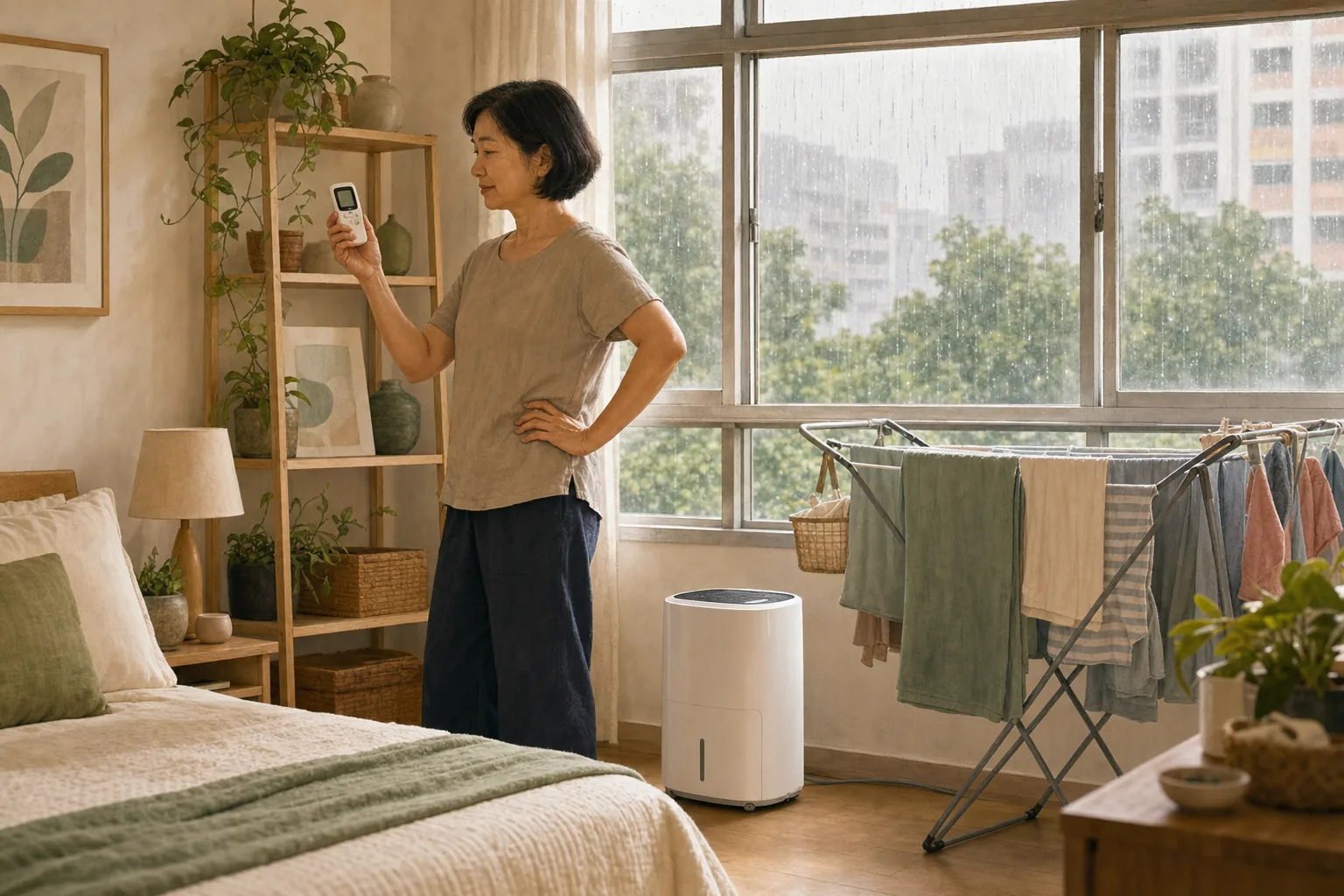
What to check before you buy a dehumidifier
With no label to compare, the spec sheet is your only common ground, so ask for it before paying.
- Rated power in watts. It drives the running cost.
- Extraction capacity and its test conditions. Capacity is usually quoted in litres a day; ask for the temperature and humidity it was measured at, because figures measured under different conditions are not comparable.
- Tank size and auto shut-off. A small tank can fill overnight in a damp room. Check that the unit stops when the tank is full.
- Continuous drainage. To run it unattended, check for a hose outlet and a drain point within reach.
- A humidity setting. Without one, the unit runs until you switch it off, which makes it cost the full figures above.
- Noise. For a bedroom, ask for the noise level at the setting you will use.
- The plug and the adaptor. The appliance needs no SAFETY Mark of its own, but 13-amp rectangular and 15-amp round 3-pin plugs are controlled goods that need a separate one, the CPSO's consumer FAQ says. So are multi-way adaptors. The FAQ explains how to check a mark's registration number online, worth doing for the plug of a unit from an overseas marketplace seller.
- Return terms. A dehumidifier's value only shows in your room, so check the return window before buying; our home trial test plan sets out how to use one.
A one-week test for a damp room
Before buying, or in the first week of a return window, a cheap humidity meter tells you more than a showroom.
- Days 1 and 2: measure the room as it is. Read the meter at about 7am and 3pm. If the afternoon reading falls with the weather, as the MSS pattern suggests, the room may need airflow rather than a machine.
- Days 3 and 4: try what you already own. Run the air-con at the 25°C NEA suggests in its energy saving tips, or a fan with the window open on a dry afternoon, and read the meter again.
- Days 5 to 7: run the dehumidifier with the door closed. Note the water collected each morning, the meter readings and the hours it ran.
- Decide. Keep it if the room is clearly drier on the same kind of day and the monthly cost, worked out as above, is worth it to you.
More guides on weighing up running costs are in the comparing topic.
Common questions
Do dehumidifiers in Singapore have an energy label?
No. NEA's mandatory energy label covers air-conditioners, refrigerators, clothes dryers, televisions, lamps and water heaters, so compare a dehumidifier's rated watts and stated capacity yourself.
How much does a dehumidifier cost to run in Singapore?
At 31.16 cents/kWh, the tariff from October to December 2026, a 200 W unit running 8 hours a night uses 1.6 kWh, about 50 cents, or about S$15 over 30 nights.
Is air-con dry mode better than a dehumidifier?
It depends on the room and the unit. An air-con removes moisture while it cools, but NEA warns that an oversized one may not dehumidify adequately. Check your model's manual, and measure the room before buying a second machine.
Can I use Climate Vouchers to buy a dehumidifier?
No. The vouchers cover 12 types of energy- and water-efficient products, such as 5-tick air-conditioners and clothes dryers, and dehumidifiers are not among them.
Sources
- tariff information page spgroup.com.sg
- climate page weather.gov.sg
- fortnightly outlook nea.gov.sg
- scheme page nea.gov.sg
- list consumerproductsafety.gov.sg
- FAQ climate-friendly-households.gov.sg
- buying tips nea.gov.sg
- energy label page nea.gov.sg
- CPSO's consumer FAQ consumerproductsafety.gov.sg
- energy saving tips nea.gov.sg
Something changed or worth adding?
Send a correction or suggestion

