
A SAFETY Mark is the label Singapore requires on 33 categories of household electrical, electronic and gas goods, from hair dryers, kettles and fans to decorative lighting chains and multi-way adaptors, before they can be sold here. If one of them is on your Christmas list, check the mark on the product and its 3-pin plug, look up its 8-digit number in the Consumer Product Safety Office (CPSO) register and check the recall pages. Toys and power banks are not on the list and need no SAFETY Mark, and an appliance bought abroad may not be safe on Singapore's 230 V supply.
At a glance
- 28 March 2025: the CPSO said it found more than 6,900 online listings of controlled goods in 2024 with no valid SAFETY Mark or registration, on platforms including Carousell, Lazada, Shopee and TikTok, more than double the yearly average of about 3,000 from 2021 to 2023.
- 13 November 2025: the Competition and Consumer Commission of Singapore (CCS) warned consumers about safety risks when buying baby products and children's jewellery online, its news and media page shows.
- 3 December 2025: the CPSO's electrical recalls page lists a Belkin recall of portable power banks and wireless charging stands over fire and burn hazards.
- 18 March 2026: the CPSO issued a circular titled "Legal action taken for the supply of unregistered Controlled Goods".
- 2 June 2026: the same page dates BenQ Singapore's recall of all GV31 Portable Mini Projectors, over a battery overheating issue that may cause a fire hazard.
- 23 June 2026: the CPSO's list of controlled goods was last updated.
- 10 November 2026: the CPSO's news page lists a safety advisory on the ELBA EBD602S tumble dryer, its newest item when we rechecked on 20 November; we could not open the advisory itself. If you own that model, check the notice on the CPSO site.
Which gifts need a SAFETY Mark?
The categories most likely to be gifts or festive buys:
- Personal care: hair dryers, curlers, straighteners and stylers; irons.
- Kitchen: kettles, air pots and hot water dispensers; coffee makers, slow cookers and steamboats; toasters, grills, hot plates (including induction), deep fryers and electric woks; mixers, blenders and mincers; rice cookers; microwave ovens.
- Home: table, standing, wall and ceiling fans; table and standing lamps; decorative lighting chains; vacuum cleaners.
- Entertainment: audio and video products, and home computer systems with their monitor, printer and speakers.
- Power: AC adaptors and chargers, multi-way adaptors, portable socket outlets including cable reels, and 13-amp and 15-amp plugs.
- Gas: portable gas cookers and their non-refillable gas canisters of up to 1.4 litres.
Refrigerators, washing machines, water heaters and room air-conditioners are on it too. The toaster and deep-fryer category covers appliances that cook with "heated medium such as air and cooking oil"; we read that as including air fryers, but the list does not name them, so check the register for the model.
Not named on the list: toys, power banks, and phones or tablets themselves. A mains charger is different: the CPSO's power adaptor tips say power adaptors, which include chargers for devices such as computers and mobile telecommunication devices, are one of the 33 categories and must carry the SAFETY Mark. Toys, children's products, furniture, mattresses and sports goods must meet an applicable safety standard but need no approval before sale; the CPSO checks them once on sale, its page on general consumer goods says.
How do you check that a SAFETY Mark is real?
The CPSO's SAFETY Mark page describes the label and sets out the register search; together they give four checks:
- Find the label. It must be in a prominent place on the product or its packaging: the safety logo, with the words "SAFETY MARK" in a rectangle on the right, and a unique 8-digit registration number.
- Look for two marks. An appliance with a 3-pin plug should carry one on the appliance and another on the plug.
- Search the register. Enter the model number or the 8-digit number in the Register of Registered Controlled Goods.
- Match the result. Check that the mark has not expired and that the brand and model in the result are the product in front of you.
An expired mark is not automatically a problem: the CPSO's consumer FAQ says a product bought from a retailer before the expiry date is compliant. If the number does not match the database, or a controlled good has no mark at all, the FAQ says you can report it through the "Report" button on the CPSA+ portal.
Buying online or overseas: what changes?
In the CPSO's 2024 findings, kitchen countertop appliances such as kettles, coffee machines, slow cookers and blenders made up about 60% of the non-compliant online listings, with portable socket outlets and hair care appliances also prominent. The CPSO said it worked with the platforms to remove all the non-compliant listings, and that anyone found guilty of selling unregistered controlled goods is liable to a fine of up to S$10,000, up to two years' jail, or both.
Its online shopping tips warn that overseas products may not meet Singapore's requirements and you may have limited recourse, so ask the seller about the SAFETY Mark, plug and voltage. Two checks matter most for anything bought abroad:
- Voltage. Singapore's supply is 230 V at 50 Hz. Appliances rated at 100 to 120 V, specifically those with motors or heating elements such as hair dryers, travel irons and kettles, will not operate safely at 230 V and could overheat, the CPSO's page on universal socket outlets says.
- The plug. The CPSO's guide to mains plugs lists the 13-amp three-pin plug for most appliances, the 15-amp round-pin plug for energy-hungry ones, and the 2.5-amp two-pin plug for low-power, double-insulated devices, used with an adaptor such as a fused conversion plug. German Schuko plugs are unsuitable.
Universal socket outlets, which take many countries' plugs, cannot meet Singapore's standard or be registered with a SAFETY Mark, and the CPSO warns against using them in homes. Ordering from an overseas site? Our GST on overseas purchases calculator shows the tax, and our guide to buying a phone or router overseas covers IMDA's rules.
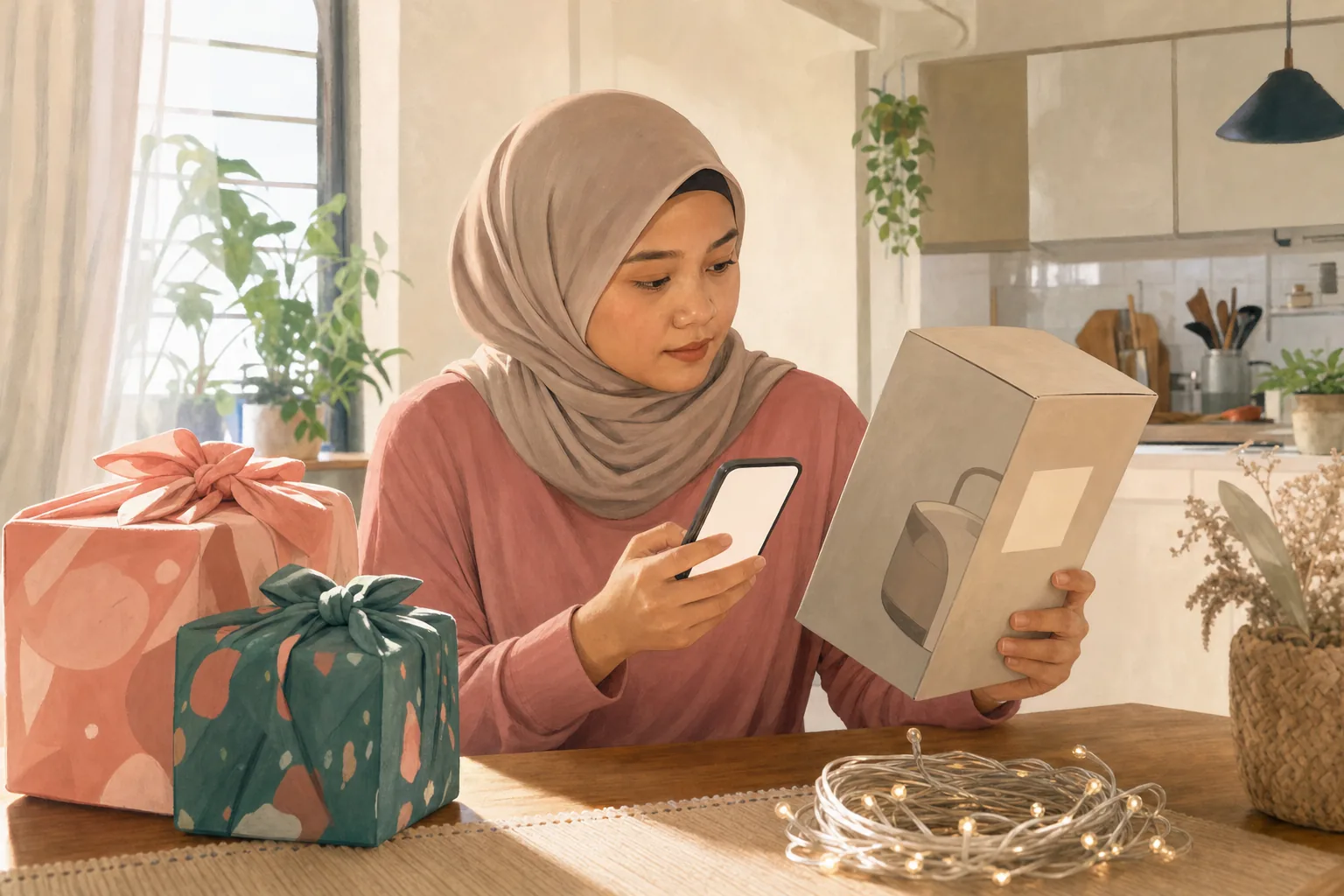
Worked example: checking a year-end gift list
The shopper is invented; the rules are the CPSO's. Nurul has seven things to buy before Christmas:
- Fairy lights for the living room. A decorative lighting chain, so a controlled good. The CPSO's decorative lighting tips add: keep indoor lights indoors, unwind extensions, test them before putting them up, and switch them off at bedtime or when you go out.
- A hair straightener from a marketplace seller. Controlled. Look for the mark in the listing photos, then check the number and the plug's mark on arrival.
- A kettle spotted in a Tokyo shop, rated 100 V. Skip it: a heating appliance at 100 V will not operate safely on Singapore's supply.
- A power bank for her father. No SAFETY Mark, but recalls happen, as Belkin's shows; check the model on the recalls page. For flights, see our power bank guide.
- A building set for her nephew. A general consumer good: check the age recommendation, instructions and maker's details, look for sharp edges and loose parts, and check the CPSO's children's toys alerts, which include magnetic building block sets.
- A universal socket outlet for the guest room, for visitors' overseas chargers. Skip it. For a device with a 2.5-amp two-pin round-pin plug, the CPSO suggests a suitable adaptor such as a fused conversion plug instead.
- A second-hand coffee machine on Carousell. Coffee makers are a controlled category. The CPSO's FAQ puts used or second-hand general consumer goods outside its remit but does not say how the rules treat a used controlled good; our reading is that the mark is still worth checking, so ask for the SAFETY Mark number, look it up, and run our second-hand hand-over test.
What it shows: the SAFETY Mark check applies to only three of the seven (the lights, the straightener and, on our reading, the used coffee machine). The kettle fails on voltage, the universal socket cannot be registered with a mark, and the power bank and the toy need the recall pages and a careful look instead.
What if a gift is recalled or turns out unsafe?
Follow the recall notice. BenQ's GV31 notice, for example, tells owners to stop using the projector immediately and offers a free battery service and firmware update or a free upgrade to a GV32. The CPSO's FAQ suggests checking for recalls and, where possible, registering a purchase with the maker to receive important updates directly.
The CPSO, which its FAQ now calls the CCS Consumer Product Safety Office, handles safety, not refunds or after-sales disputes; for those, its FAQ points consumers to the Consumers Association of Singapore (CASE). For a faulty item, our Lemon Law action plan sets out the next steps. For more guides on checking a purchase first, see our trying topic.
Common questions
Do all electrical products in Singapore need a SAFETY Mark?
No; only the 33 categories of controlled goods, such as hair dryers, kettles, fans, decorative lighting chains and adaptors, not toys or power banks.
How do I check a SAFETY Mark number?
Enter the model number or the 8-digit number on the label in the Register of Registered Controlled Goods, then check that the mark has not expired and the result matches your product.
Can I use an appliance I bought in Japan or the US?
Check its voltage first; the CPSO says appliances rated at 100 to 120 V with motors or heating elements, such as hair dryers, travel irons and kettles, will not operate safely at Singapore's 230 V.
Who do I contact for a refund on an unsafe product?
The CPSO handles safety, not refunds; it points consumers to CASE.
Sources
- found more than 6,900 online listings consumerproductsafety.gov.sg
- news and media page consumerproductsafety.gov.sg
- electrical recalls page consumerproductsafety.gov.sg
- list of controlled goods consumerproductsafety.gov.sg
- power adaptor tips consumerproductsafety.gov.sg
- page on general consumer goods consumerproductsafety.gov.sg
- SAFETY Mark page consumerproductsafety.gov.sg
- consumer FAQ consumerproductsafety.gov.sg
- online shopping tips consumerproductsafety.gov.sg
- page on universal socket outlets consumerproductsafety.gov.sg
- guide to mains plugs consumerproductsafety.gov.sg
- decorative lighting tips consumerproductsafety.gov.sg
- children's toys alerts consumerproductsafety.gov.sg
Something changed or worth adding?
Send a correction or suggestion

