
From 1 January 2027, Singapore stops the import, export and manufacture of four more kinds of fluorescent lamp, and on 1 January 2028 triband tubes, including U-bend and circular ones, follow. You do not have to take down a fluorescent lamp that works: the National Environment Agency (NEA) says stock brought in before each date can still be sold and used until it runs out. What changes is your next replacement, which will increasingly be an LED, so it pays to know how to compare one by its label and where the old tube should go.
At a glance
- 1 April 2024: NEA's energy label and minimum standards were extended to all T8 and T5 linear fluorescent and LED tubes, according to its page on the energy labelling scheme.
- 20 April 2026: NEA told traders, in a circular on six mercury-added lighting products, that it would control them as hazardous substances under the Environmental Protection and Management Act and phase out their import, export and manufacture, in line with the Minamata Convention on mercury.
- 1 January 2027: no more import, export or manufacture of compact fluorescent lamps above 30 watts, plug-in compact fluorescent lamps with a separate ballast (30 watts or less, with no more than 5mg of mercury per lamp burner), and halophosphate linear, U-bend and circular tubes.
- 1 January 2028: the same applies to triband linear tubes and triband U-bend and circular tubes.
- Both dates: lamps imported before the date may still be sold and used locally until stocks are depleted.
Which fluorescent lamps does the 2027 rule cover?
NEA's circular lists the products by type, wattage, phosphor and mercury content. In plain terms:
- Compact fluorescent lamps (CFLs) above 30 watts for general lighting.
- Plug-in CFLs without a built-in ballast (the kind that slots into a separate fitting) of 30 watts or less with no more than 5mg of mercury per burner.
- Halophosphate linear tubes, the straight kind: those of 40 watts or less with no more than 10mg of mercury, and all those above 40 watts.
- Halophosphate U-bend and circular tubes.
From 1 January 2028 the controls reach triband linear tubes (below 60 watts with no more than 5mg of mercury, and 60 watts or more at any mercury content) and triband U-bend and circular tubes. The circular says CFL bulbs with a built-in ballast of 30 watts or less, and tubes over set mercury limits, were phased out earlier.
Whether your tube is halophosphate or triband hardly matters: by 2028 neither can be brought in, so, in our view, expect your next straight, U-bend or circular replacement to be an LED once shop stock sells out.
Do you have to replace working fluorescent lights?
No. The circular is addressed to licence holders, traders and declaring agents and controls import, export and manufacture. Nothing in it tells households to remove lamps, and it allows existing stock to be sold and used.
Replacing a working tube early is a question of cost, and NEA's own figures suggest the saving is modest. Its tips on buying energy-efficient appliances, last updated on 11 November 2026, say that choosing a 3-tick light bulb over a 1-tick model saves about 1% of utility costs, based on five bulbs used three hours a day at 29 cents per kWh before GST. Our suggestion for most homes is to switch to LED when a tube fails.
How do you compare LED tubes and bulbs?
The figure that matters is efficacy: rated light output in lumens divided by rated power in watts. NEA's tick rating page uses one scale for every regulated lamp:
- 1 tick: below 110 lumens per watt.
- 2 ticks: 110 to under 135.
- 3 ticks: 135 to under 160.
- 4 ticks: 160 or more.
NEA's minimum energy performance standards set the floor: 100 lumens per watt for LED bulbs and T8 or T5 LED tubes, and 75 for T8 or T5 fluorescent tubes. LED lamps must also keep at least 80% of their light output at 6,000 hours.
The label does not cover every light you might buy. NEA's list of regulated goods names 230V screw and bayonet incandescent bulbs from 25 to 200 watts, CFL and LED bulbs up to 60 watts, plug-in CFLs on G24 caps and their LED replacements, and T5 and T8 tubes from 0.5m to 1.5m long. Circular tubes are not on it, and the list does not describe ceiling fittings with LEDs built in. For anything off the list, our suggestion is to ask for lumens and watts and do the division yourself, using the tick bands as a yardstick.
For a covered lamp, NEA's energy label page says retailers may display only labelled models, and any advertisement, including an online marketplace listing, must show the label or, where that is not practical, the tick rating and registration number. NEA takes reports of unlabelled goods at NEA_energylabel@nea.gov.sg. Our guide to reading the energy label explains ticks across appliances.
A worked example: two kitchen tubes
This example is illustrative: the household and tubes are fictional, and the efficacies are NEA's thresholds, not real products. A kitchen has two tubes, each giving 2,000 lumens, on five hours a day all year. At 27 cents per kWh, the electricity rate NEA's energy labels for air-conditioners, refrigerators, clothes dryers and televisions use for annual energy cost (NEA's page does not give a running cost for the lamp label), the pair would cost:
- Fluorescent tubes at the 75 lumens per watt minimum: about 26.7 watts each, 48.7 kWh a year each, so about S$26.28 for the pair.
- LED tubes at the 2-tick threshold (110 lumens per watt): about 18.2 watts each, so about S$17.92.
- LED tubes at the 4-tick threshold (160 lumens per watt): 12.5 watts each, so about S$12.32.
On these assumptions, a 4-tick pair saves about S$14 a year against fluorescent tubes at the floor, before counting any power drawn by the fluorescent fitting's ballast, which NEA regulates separately. Your own tubes will differ, so work out yours: our appliance running cost calculator takes the watts on the box, your hours and the rate on your bill.
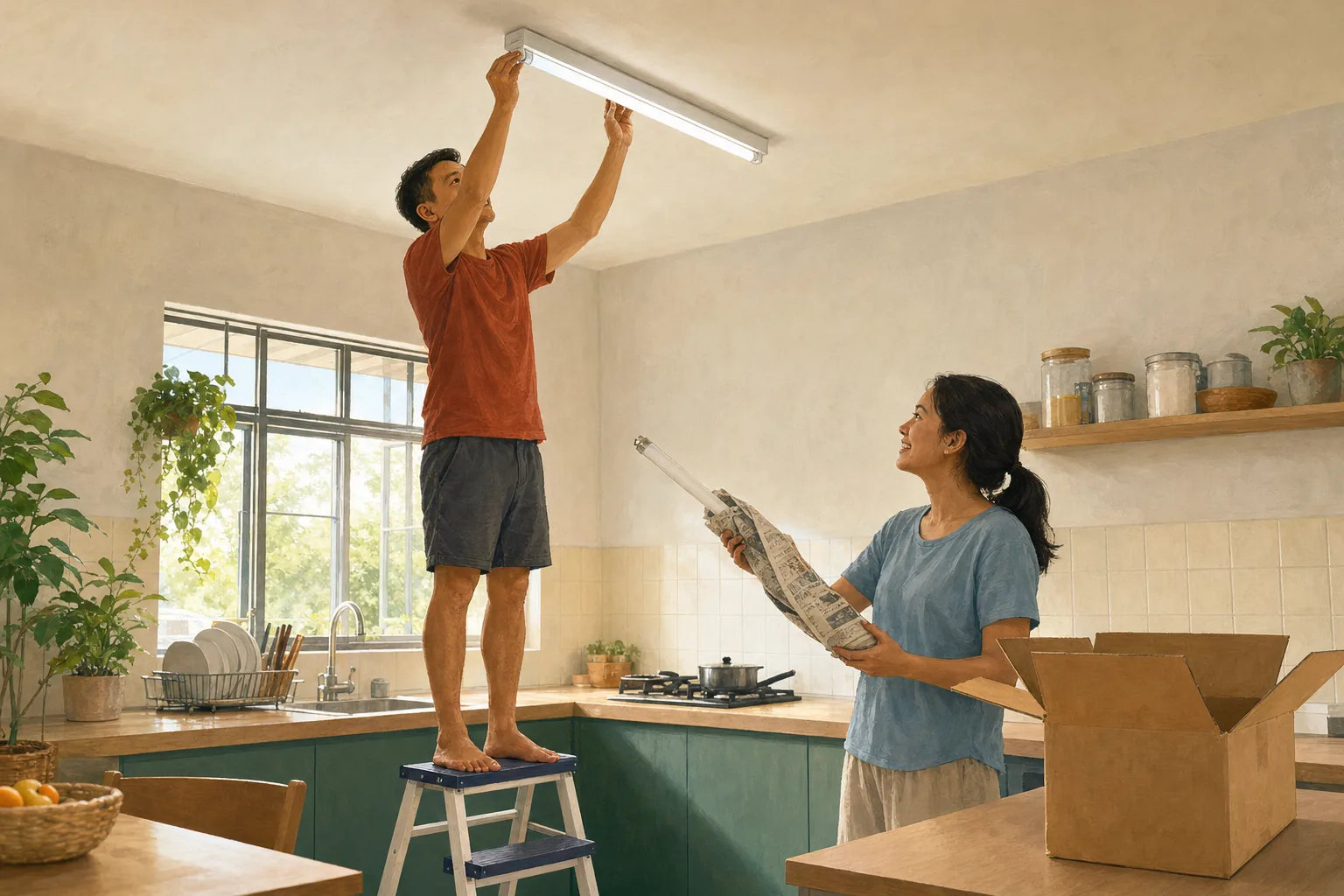
A checklist before you buy a replacement
These are our general suggestions, not NEA requirements.
- Note what you have: straight (T5 or T8, and its length), U-bend, circular or plug-in CFL, and its wattage.
- Check the LED suits your fitting. Ask the seller whether the LED tube works in your fitting as it is or needs the fitting changed, and leave any rewiring to a qualified electrician.
- Compare lumens per watt, then ticks. More lumens at the same watts means more light for the same cost.
- Check the listing. For a covered lamp, look for the energy label, or the tick rating and registration number, next to the product.
- Plan the old tube's exit before you take it down (below).
Where do old fluorescent tubes go?
NEA's circular treats these lamps as mercury-added products, and NEA's e-waste pages cover how to recycle bulbs and tubes. Its where to recycle e-waste page, last updated on 28 September 2026, sets out the routes run by ALBA E-waste Smart Recycling, the appointed Producer Responsibility Scheme operator:
- Bulbs and small lamps: ALBA's 3-in-1 bins take light bulbs up to 100mm in circumference, and its battery and bulb bins take bulbs and lamps. Bins at retail outlets that sell lamps accept bulbs and lamps of any brand.
- Long fluorescent or LED tubes: not accepted in the bins. Take them to an ALBA collection drive, which accepts long and circular fluorescent and LED tubes, or book ALBA's doorstep collection, whose fees NEA says are on ALBA's website or app. NEA's page also lists ALBA's depot at 20 Tuas Loop as taking all regulated consumer products.
NEA's page listed town council collection drives on Saturdays from 3 October to 7 November 2026, held quarterly. ALBA's own E-Drive schedule (dated June 2026) lists more rounds from 10am to 3pm on Saturdays, among them Jurong-Clementi-Bukit Batok on 21 November, Bishan-Toa Payoh on 28 November, Sembawang on 5 December, Jalan Besar on 19 December, and Pasir Ris-Changi and Punggol on 26 December 2026, then Tanjong Pagar on 2 January 2027. ALBA says locations may change, so check its website or app before you go. Our guide to e-waste recycling covers the bins and drives for other devices.
See also minimum energy standards and our comparing topic.
Common questions
Are fluorescent lights banned in Singapore from 2027?
Not for use. From 1 January 2027 NEA stops the import, export and manufacture of four types, and triband tubes follow on 1 January 2028, but stock imported before each date may still be sold and used until it runs out.
Do I need to replace fluorescent tubes that still work?
No. The rule controls trade, not lamps already in homes. Given NEA's estimate that a 3-tick bulb saves about 1% of utility costs over a 1-tick one, our suggestion is to switch to LED when a tube fails.
How do I compare LED tubes in Singapore?
Divide the rated lumens by the rated watts. On NEA's scale, below 110 lumens per watt is 1 tick and 160 or more is 4 ticks, and T5 and T8 LED tubes must reach at least 100.
Can I put a long fluorescent tube in ALBA's e-waste bins?
No. ALBA's bins do not take long fluorescent or LED tubes; NEA's page directs them to an ALBA collection drive or ALBA's doorstep collection.
Sources
- page on the energy labelling scheme nea.gov.sg
- circular on six mercury-added lighting products nea.gov.sg
- tips on buying energy-efficient appliances nea.gov.sg
- tick rating page nea.gov.sg
- minimum energy performance standards nea.gov.sg
- list of regulated goods nea.gov.sg
- energy label page nea.gov.sg
- where to recycle e-waste page nea.gov.sg
- E-Drive schedule alba-ewaste.sg
Something changed or worth adding?
Send a correction or suggestion

