
A portable aircon sold in Singapore must meet the National Environment Agency's (NEA) minimum efficiency, and the best energy label it can carry is 2 ticks. Since 1 July 2026 the same rules reach a unit you buy from an overseas website and ship in yourself: you must register the model with NEA before it is imported, it must meet the minimum standard, and a non-compliant import can draw a fine of up to S$10,000. On NEA's minimums, a portable unit also uses more power for the same cooling than a window or split unit.
At a glance
- 1 April 2024: NEA's mandatory energy label and minimum energy performance standards took effect for portable air-conditioners, according to its page on the labelling scheme.
- The minimum: a single-duct portable unit of up to 12 kW must reach a coefficient of performance (COP) of at least 3.0 at full load, under NEA's minimum energy performance standards.
- The ticks: 1 tick for a COP from 3.0 to under 3.25, and 2 ticks for 3.25 or more.
- 8 April 2026: Parliament passed the Energy Conservation (Amendment) Bill, according to NEA's circular of 24 April 2026. It extends these rules to regulated goods imported by households and businesses for their own use.
- 1 July 2026: an own-use import must be registered with NEA before it comes in, meet the minimum and carry the energy label where one is required. Registration is free and NEA says it processes applications within seven working days.
- Also from 1 July 2026: a visual advertisement of a regulated appliance, including an online marketplace listing, must show the energy label, or where that is not practical its tick rating and registration number.
What counts as a portable aircon under NEA's rules?
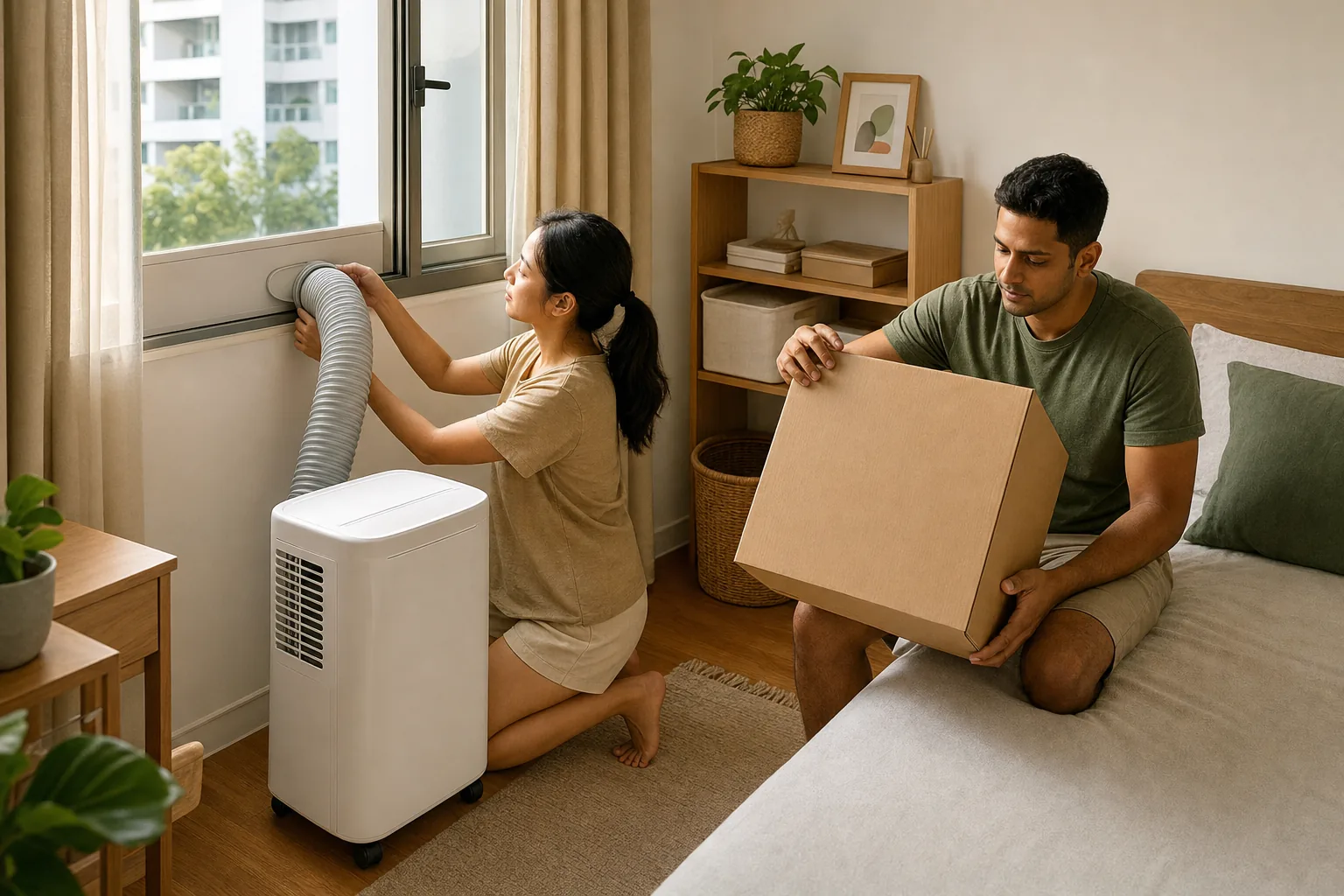
NEA's list of regulated goods covers a single-phase portable air-conditioner with a single exhaust duct and a rated cooling capacity of 12 kW or less, that is not second-hand. In NEA's description, the unit sits wholly inside the room it cools, draws its air from that room and discharges air outside the room through a single duct.
Two things follow. The duct has to go somewhere: our reading is that you need a window or opening where the hose can vent. And the definition names a single duct only. A dual-duct unit, or a fan-and-water "air cooler" with no compressor, does not match the description as written; that is our inference, so ask NEA if you are unsure whether a product is covered.
How do ticks work on a portable aircon?
NEA's tick rating page uses COP, the cooling delivered divided by the electricity drawn at full load. A higher COP means less power for the same cooling:
- 1 tick: COP from 3.0 to under 3.25.
- 2 ticks: COP of 3.25 or more.
Anything below 3.0 cannot be sold. NEA's energy label page notes that portable units are rated from 1 to 2 ticks only, so a 2-tick portable is the top of its own scale. Ticks are not comparable across types: on NEA's table a casement or window unit rates 2 to 5 ticks and a single-split unit 4 or 5.
The more useful figures on the label are the annual energy consumption in kWh and the annual energy cost. For single-phase air-conditioners, portable ones included, both assume 8 hours of use a day plus 16 hours on standby, and the cost uses 27 cents per kWh. Because the hours and the rate are the same for every single-phase air-conditioner's label, our reading is that these figures are a fairer way to compare portable, window and split models of similar capacity than ticks, which follow a separate scale for each type. Our guide to reading the energy label covers other appliances.
Is a portable aircon cheaper to run than a window or split unit?
Not on NEA's minimums. The minimum standards page, last updated 23 October 2026, sets full-load COP floors of above 3.78 for casement and window units and above 4.86 for single-split non-inverter units, against 3.0 for portables. Inverter splits are judged on a weighted COP that blends full and half load, so their floor cannot be set beside these numbers directly.
A worked example: one bedroom, a month of nights
This example is illustrative: the room and the 2.6 kW cooling capacity are invented, and each COP is NEA's threshold, not a real product. If each unit ran at full output for 8 hours a night for 30 nights, at 27 cents per kWh (the label rate):
- Portable at the 3.0 minimum: about 867 watts, 208 kWh, about S$56.16.
- Portable at the 2-tick threshold (3.25): 800 watts, 192 kWh, about S$51.84.
- Window unit at the 3.78 floor: about 688 watts, 165 kWh, about S$44.57.
- Single-split non-inverter at the 4.86 floor: about 535 watts, 128 kWh, about S$34.67.
Treat these as an upper bound: a unit rarely runs flat out all night, and your tariff will differ. The gaps are what count. On these assumptions, a 2-tick portable saves about S$4 a month over one at the minimum, and a split at its minimum saves about S$21 a month over the portable at its minimum. Our view: a portable suits a room where a fixed unit cannot be installed or a short-term need, and a fixed unit usually costs less to run where one is allowed. Try your own figures in the appliance running cost calculator, and see our guide to electricity tariffs and running costs for the current rate.
Can you buy a portable aircon from an overseas website?
Yes, but since 1 July 2026 it must clear the same bar as one sold in a local shop. NEA's news release of 24 June 2026 explains that goods imported by households and businesses for their own use used to fall outside the scheme, and that online marketplaces had made it easy to import goods that are often inefficient. NEA had consulted on the change in January 2026, and its circular of 24 June 2026 says an individual or company that imports a non-compliant regulated good for own use may be fined up to S$10,000.
NEA's page on importing regulated goods for own use shows the rule also covers room air-conditioners, refrigerators, clothes dryers, televisions and household water heaters.
In the Bill's closing speech on 8 April 2026, Senior Minister of State Janil Puthucheary set out points a buyer should know:
- Second-hand goods are excluded, unless they are imported for resale as new. Lights are excluded too.
- Each importer registers, even if someone else has already registered the same model, and the fine applies per import.
- No checks at the border, for now: the Government had assessed that there was no need for controls at the point of import at that time; NEA will check business establishments as needed and act on whistleblowing reports.
- Intermediaries: where a small or medium-sized business imports through a contractor or interior designer, the intermediary importing the goods is responsible for compliance.
- Manufacturers' test reports can be used, so no extra testing should be needed if the maker supplies one.
What does NEA's registration ask for?
According to NEA's own-use import page, last updated 1 July 2026:
- Register on NEA's ELS online portal before importing, with Singpass for an individual.
- Submit a test report on NEA's test report template, plus the lab's ISO/IEC 17025 certificate and accreditation if a third-party lab did the testing.
- Add any other documents needed, which NEA's example says can include in-principle approval from the Singapore Civil Defence Force for equipment using a flammable refrigerant.
- Receive a Certificate of Registration, valid for three years; renew it between 90 days and two weeks before expiry to import the same model again.
There is no fee. Our view is that the test report is the hard part: an overseas seller may not have one in NEA's format, and then a labelled model sold locally is the simpler route.
A checklist before you buy a portable aircon
These are our suggestions, not NEA requirements.
- Check the room. Is there a window or opening the duct can vent through, and will the landlord or management allow it?
- Compare kWh, not only ticks. Read the annual energy consumption and cost on the labels of units with similar cooling capacity.
- Check the listing. Since 1 July 2026 a local listing should show the energy label, or the tick rating and registration number. NEA asks consumers to buy only registered appliances and to report unlabelled or unregistered ones to NEA_energylabel@nea.gov.sg.
- Buying from overseas? Ask the seller for a test report before you pay, register on NEA's portal first, and budget for GST on the import; our guide to GST on overseas purchases explains how it is charged.
- Using Climate Vouchers? The speech says eligible households can use the S$400 in vouchers until 31 December 2027 and NEA's release says they cover eligible energy-efficient regulated goods; we did not check whether any portable model is eligible, so see our Climate Vouchers shortlist.
See also minimum energy standards, air-con size for Singapore rooms, buying a phone or router overseas and our comparing topic.
Common questions
Can I bring a portable aircon into Singapore from an overseas website?
Yes. Since 1 July 2026 a new unit's model must meet NEA's minimum COP of 3.0 and be registered with NEA before import, and whoever imports a non-compliant unit for own use can be fined up to S$10,000.
Does registering an imported aircon with NEA cost anything?
No. NEA says registration and renewal are free for goods imported for own use, applications are processed within seven working days and the certificate lasts three years.
What is a good energy rating for a portable aircon in Singapore?
Portable units are rated 1 or 2 ticks only: 2 ticks means a COP of 3.25 or more. Compare the label's annual kWh against other units of similar cooling capacity too.
Does the own-use import rule apply to a second-hand aircon?
No. The Senior Minister of State told Parliament that second-hand goods are excluded, unless they are imported to be resold as new.
Sources
- page on the labelling scheme nea.gov.sg
- minimum energy performance standards nea.gov.sg
- circular of 24 April 2026 nea.gov.sg
- list of regulated goods nea.gov.sg
- tick rating page nea.gov.sg
- energy label page nea.gov.sg
- news release of 24 June 2026 nea.gov.sg
- consulted on the change in January 2026 reach.gov.sg
- circular of 24 June 2026 nea.gov.sg
- importing regulated goods for own use nea.gov.sg
- closing speech on 8 April 2026 mse.gov.sg
Something changed or worth adding?
Send a correction or suggestion

