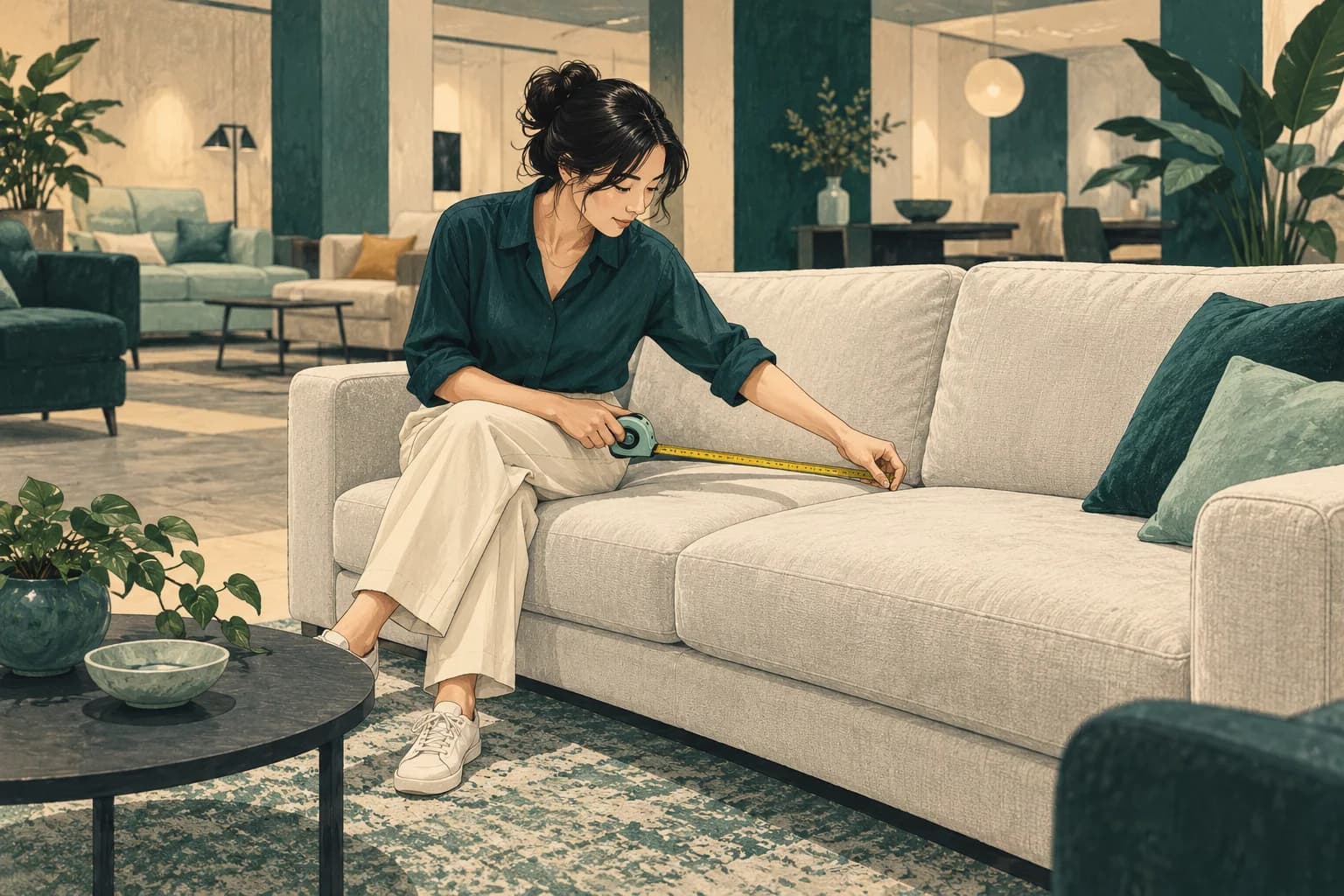
A sofa should be tested against the room, the delivery path and the people who will use it. Sitting on a showroom model for one minute may reveal comfort, but it will not tell you whether the delivered item fits through the lift or whether the fabric can be cared for at home. Take measurements and the written offer to the shop.
What should you measure before visiting?
Measure the intended floor space, walking clearance, doorway, lift, corridor and any tight turn. Note which side a chaise must face. For an illustrative living room with a 2.4-metre wall, a 2.2-metre sofa may still be unsuitable if the door swing or table leaves too little room to walk. This room is fictional. Tape the sofa footprint on the floor if possible, and photograph the delivery route. Ask the seller for packaged dimensions and whether legs or sections can be detached without voiding a warranty.
In the shop, sit in each usual position for several minutes. Check seat depth, back support, height for standing up and whether two people can sit comfortably without one being pushed to an edge. Ask for fabric composition and cleaning instructions, and inspect seams and cushion recovery. If pets or children will use the sofa, request a sample or care sheet rather than accepting an unsupported “stain-proof” claim. CCCS's guide on quality-related claims offers a useful standard for questioning broad product claims, while the precise sofa claim must be checked against seller evidence.
How do you compare the payable offer?
Ask for model, dimensions, fabric code, colour, lead time, deposit, delivery fee, assembly, removal of the old item, return conditions, defect process and warranty exclusions in writing. CCCS's price-transparency guidance helps frame a comparison of total price and promotional conditions. A fictional Store A might include delivery but exclude carrying a sofa up stairs; Store B might price stair access upfront. If your building lift is unavailable on delivery day, those terms may matter more than a small difference in sticker price.
Ask whether the displayed model and delivered model have identical materials and dimensions. Photograph the product label or quote reference. If an order is made to measure, confirm how the seller handles a change of mind, a manufacturing defect and a delivery failure; do not assume ordinary return terms apply. CASE's consumer information and complaint routes offer a starting point if a dispute later arises, but a specific remedy depends on the facts and applicable law.
What should happen at delivery?
Clear the path and have an adult present to compare the delivered product with the order. Inspect the visible frame, fabric, legs and cushions before signing an unqualified acceptance. Note damage on the delivery record and take dated photographs. Try the sofa in the actual room and keep packaging until the agreed inspection process is complete if space allows. The moving-quote guide helps plan access for bulky items; the extended-warranty guide helps assess any added cover. Browse comparison guides for other big-ticket decisions.
You can send TBYB a sofa-offer question for editorial guidance. We do not sell furniture or promise a retailer match.
Common questions
Are showroom dimensions enough to approve delivery?
Check packaged size, building access and any detachable sections with the seller.
Does “stain-proof” mean every mark is covered?
Ask for the exact evidence, cleaning method and warranty wording behind the claim.
Should I sign the delivery record before inspecting?
Inspect promptly and record visible discrepancies according to the seller's delivery process.
Sources
- guide on quality-related claims ccs.gov.sg
- price-transparency guidance ccs.gov.sg
- consumer information and complaint routes case.org.sg
Something changed or worth adding?
Send a correction or suggestion