
If you own more than two power banks and are flying out of Singapore these holidays, decide before you leave home which two you will carry. Since 15 April 2026, the Civil Aviation Authority of Singapore (CAAS) has limited passengers departing Singapore to two power banks each. Anyone carrying more must dispose of the extras before the flight, power banks may not be charged on board, and they still cannot go in check-in baggage. A third one taken to Changi does not get on the plane, so recycle it before you go.
Below: the rule, how to read a label's capacity in watt-hours (Wh), an illustrative family packing list, and where to recycle the rest.
At a glance
- 2 April 2026: ICAO, the international civil aviation body, issued an addendum to its dangerous goods instructions setting a maximum of two power banks per passenger.
- 6 April 2026: CAAS announced the restrictions for flights departing Singapore.
- From 15 April 2026, 0001hrs: a maximum of two power banks per person on board; excess power banks must be disposed of before the flight; no charging power banks on board, and passengers are advised not to use them to charge devices during the flight.
- Still in force: no power banks in check-in baggage, capacity limits, and each power bank individually protected against short circuit, for example in a protective pouch.
- 21 November to 31 December 2026: the year-end school holidays for primary and secondary schools, according to MOE's academic calendar (last updated 2 June 2026).
- 24 October, 31 October and 7 November 2026: ALBA e-waste collection drives in several town council estates, which accept power banks.
How many power banks can I bring on a plane from Singapore?
Two per person, in your cabin bag, on any flight departing Singapore. CAAS says lithium batteries in power banks can overheat or short-circuit and pose a fire hazard on board. The limit is per passenger: a family of four may carry up to eight, but no more than two each.
Three details catch travellers out:
- Checked bags are off limits. CAAS lists the ban on power banks in check-in baggage among the existing requirements that continue to apply.
- No charging in flight. You may not charge the power bank on board, and CAAS advises against using it to charge your phone during the flight, so charge everything at home.
- Your airline can be stricter. CAAS says airlines may have more restrictive policies and advises passengers to check before travelling. The release covers flights departing Singapore; it does not set the rules for your flight home, so check the airline for that leg too.
CAAS says capacity limits continue to apply but does not state the figures in its release, and we could not open the airlines' or Changi Airport's pages today. So this guide quotes no Wh ceiling: find it on your airline's baggage page and compare it with your power bank using the method below.
How do I convert a power bank's mAh to Wh?
Airline limits are written in watt-hours; boxes usually lead with milliamp-hours. Many labels also print a figure followed by "Wh". If yours does not, use the battery's rated voltage printed next to the mAh figure (for lithium cells this is often 3.6 V or 3.7 V, not the 5 V USB output):
Wh = mAh × V ÷ 1,000
Our arithmetic for common sizes:
- 5,000 mAh at 3.7 V: 18.5 Wh.
- 10,000 mAh at 3.7 V: 37 Wh.
- 20,000 mAh at 3.6 V: 72 Wh.
- 26,800 mAh at 3.6 V: about 96.5 Wh.
Our suggestion: leave at home any power bank whose label is worn off, and recycle rather than fly with one that is swollen, dented or gets unusually hot when charging.
Buying one for the trip? Choose by the Wh printed on the label, and get a pouch for it. The Consumer Product Safety Office's power bank pages could not be opened today, so this guide does not describe the safety requirements for power banks sold in Singapore.
A worked example: a family packing for the year-end holidays
This household is illustrative. Farah and Jason fly out with their children, aged 9 and 14, at the start of the school holidays. A drawer search turns up six power banks:
- A 10,000 mAh at 3.7 V model bought last year: 37 Wh, label clear.
- A 20,000 mAh at 3.6 V model: 72 Wh, label clear.
- A 5,000 mAh at 3.7 V slim one: 18.5 Wh, label clear.
- A 10,000 mAh conference giveaway: label rubbed off.
- A 20,000 mAh at 3.7 V model: 74 Wh, but it has started to bulge.
- A 5,000 mAh at 3.7 V model with a cracked case: 18.5 Wh.
The rule would allow up to eight; condition is the real filter. They pack items 1, 2 and 3, one each for Farah, Jason and the 14-year-old, each in its own pouch in a cabin bag, after checking the airline's limit against 72 Wh, the largest. Items 4, 5 and 6 stay behind (no readable capacity, swollen, damaged): taped up and dropped into an e-waste bin that takes power banks the week before the flight. Nothing is surrendered at the airport.
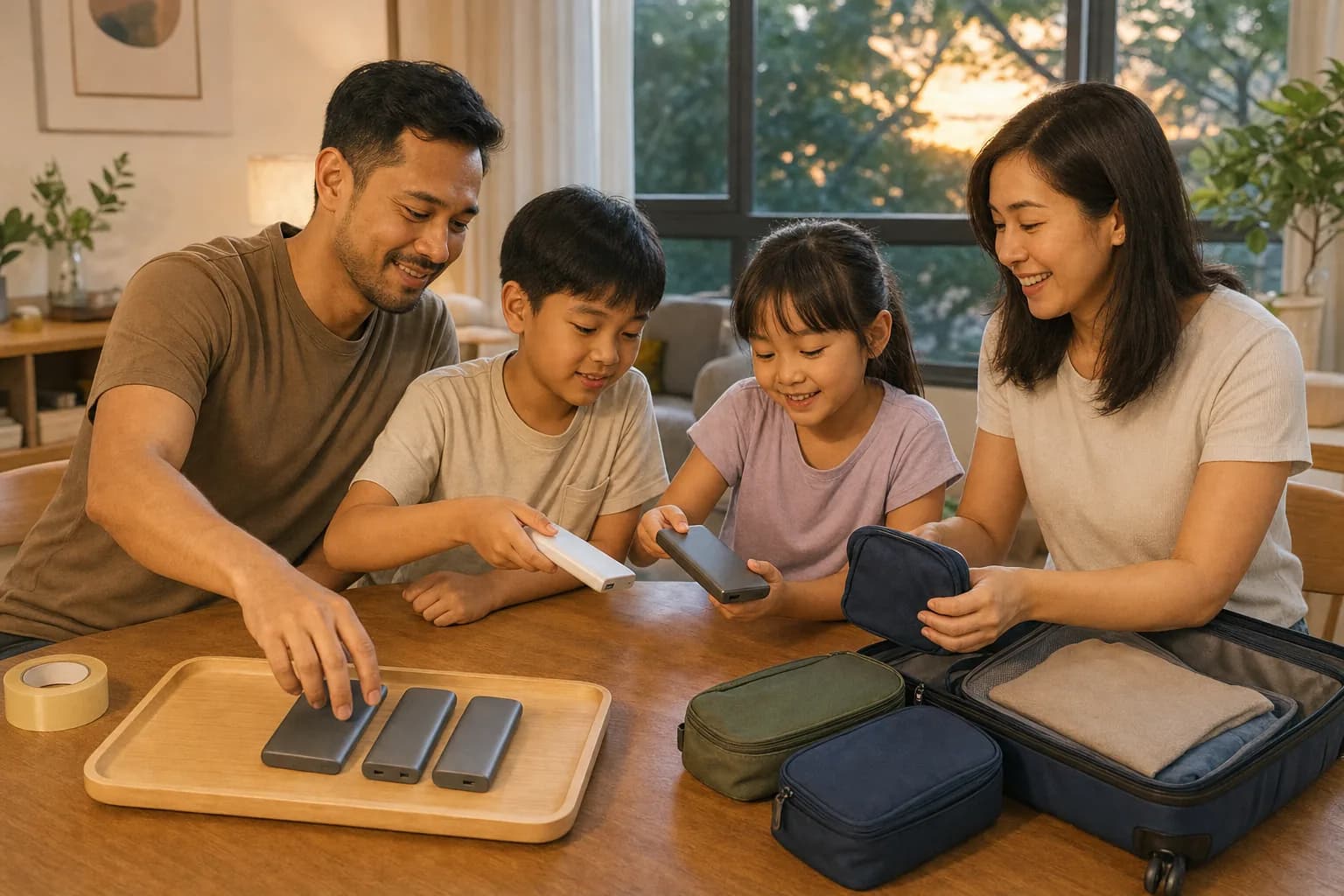
Packing checklist before you leave for Changi
- Count per person: no more than two in each traveller's carry-on.
- Read the Wh and compare it with your airline's limit.
- Protect each one against short circuit, for example in a pouch.
- Nothing in checked bags.
- Charge at home.
- Check the return leg with the airline.
- Recycle the rest before the trip.
What should I do with power banks I am not taking?
Not in the rubbish chute or a blue recycling bin. NEA's where to recycle e-waste page (last updated 28 September 2026) says batteries must not go in general or blue bins, and asks you to tape the ends or wires of rechargeable batteries and seal any leaking battery in a leak-proof bag to reduce the risk of short circuits and fire.
Not every bin takes power banks:
- ALBA's 3-in-1 bin (ICT, batteries and lamps) lists power banks among the ICT items it accepts, if they fit the 500 mm × 250 mm slot.
- The Battery & Bulb bin and the batteries-only bin do not accept ICT items; they take batteries such as AA, AAA and button cells.
- Manned in-store counters accept ICT equipment and batteries.
- ALBA's collection drives and doorstep collection accept power banks too. NEA lists drives from 10am to 3pm: Aljunied-Hougang Town Council on 24 October, Holland-Bukit Panjang and West Coast-Jurong West on 31 October, and Ang Mo Kio and Jalan Kayu on 7 November 2026. Fees for doorstep collection are on ALBA's site.
Power banks are regulated products under the e-waste scheme. NEA's extended producer responsibility page (last updated 28 September 2026) lists them as portable batteries, and says retailers of regulated products with a store of 300 square metres or more must offer in-store collection of the same type of product they sell there. NEA's where to recycle page adds that retailer in-store collection is open to the public with or without a purchase.
For phones, tablets and laptops, our e-waste recycling guide covers the data-secure drop-off trial, and trade in or recycle an old phone or laptop helps you decide whether a device still has value. Shopping on the trip? Read GST relief for travellers before you fly home. More guides on looking after what you own are in the ownership topic.
Common questions
How many power banks can I bring on a flight from Singapore?
Two per person, in the cabin, on flights departing Singapore since 15 April 2026; extras must be disposed of before the flight, and your airline may be stricter.
Can I put a power bank in my checked luggage?
No. CAAS says the ban on power banks in check-in baggage continues to apply, so they travel only in the cabin, each protected against short circuit.
How do I work out the Wh of a 20,000 mAh power bank?
Multiply the mAh by the battery voltage on the label and divide by 1,000: at 3.6 V, 20,000 mAh is 72 Wh. Compare that with your airline's published limit.
Where can I throw away an old power bank in Singapore?
In an ALBA 3-in-1 e-waste bin, at an in-store counter or collection drive, with the ends taped; never in general or blue bins.
Sources
- announced the restrictions for flights departing Singapore caas.gov.sg
- MOE's academic calendar moe.gov.sg
- where to recycle e-waste page nea.gov.sg
- extended producer responsibility page nea.gov.sg
Something changed or worth adding?
Send a correction or suggestion

