
Buying a mobility scooter in Singapore now means three checks before you pay. Since 1 June 2026 the rider needs a Certificate of Medical Need unless exempt (seniors aged 70 and above are), shops may sell only scooters registered with LTA, and a scooter longer than 120cm, wider than 70cm, taller than 150cm or heavier than 300kg laden is barred from public paths and public transport. Every motorised mobility aid is also limited to 6km/h on public paths.
If you already own one and use it on public paths, it will need registering by 1 January 2029; LTA plans roving registration stations from mid-2027.
At a glance
- 4 February 2026: Parliament passed the law behind the new rules, gov.sg's explainer says.
- 27 February 2026: the Assessment for Mobility Scooter and OneMotoring's exemption check opened, according to LTA's release on the new rules.
- 4 May 2026: registration of shops' stock began at Authorised Inspection Centres, OneMotoring's mobility scooter page says.
- 1 June 2026: the certificate rule, the 6km/h limit, the size and weight limits and the registered-only rule for shops took effect.
- Mid-2027: LTA plans roving stations at community touchpoints to register existing scooters.
- 31 December 2028: the transition for existing devices with speed limits up to 10km/h ends; until then they may be used, at no more than 6km/h on public paths.
- 1 January 2029: riding an unregistered mobility scooter on public paths becomes an offence.
Does the rider need a Certificate of Medical Need?
Not every rider does. LTA exempts four groups:
- seniors aged 70 and above;
- people who received a subsidised mobility scooter from the Seniors' Mobility and Enabling Fund before 27 February 2026;
- existing and future recipients of a subsidised mobility scooter from the Assistive Technology Fund;
- applicants for MOH disability schemes assessed as needing help with "Mobility" or "Transferring" in their daily activities.
Everyone else must complete the Assessment for Mobility Scooter and obtain a Certificate of Medical Need before riding on public paths. A regular doctor, a regular occupational therapist or a GP can do it, and a follow-up occupational therapy assessment may be needed to check that the rider can handle the scooter safely. LTA publishes a list of GPs offering it, with indicative charges that vary with the complexity of the consultation; we could not open that list, so call the clinic first to check the service and the price.
You can check exemption or certification status on OneMotoring with an NRIC number and date of birth. One catch: the over-70 exemption does not show there. LTA says enforcement officers may ask for a rider's particulars, or the rider can show a hardcopy certification form, and will focus on visibly able-bodied people misusing scooters. Carrying an NRIC is our suggestion, not an LTA rule.
What does the shop have to check?
A mobility scooter, in OneMotoring's definition, has three or more wheels, a single footboard, handlebars (a delta tiller counts), only one seat behind the footboard, and a motor, and is designed to carry one person who cannot walk or has difficulty walking. It may use public paths, never roads. LTA classes a lookalike as a personal mobility device (PMD) rather than a mobility aid; a device with more than one seat, for example, is not a mobility scooter.
The shop's side of the sale since 1 June 2026, according to LTA and OneMotoring:
- The model must be whitelisted. LTA registers only models listed on the Health Sciences Authority's Class A Medical Device Database.
- Each unit is inspected and tagged. At an Authorised Inspection Centre a registered scooter receives a Registration Mark and an Identification Mark. The retailer pays the S$35 LTA registration fee and about S$30 for inspection and tagging per device.
- The owner is checked. Before selling, the retailer must check on OneMotoring that the prospective owner has a certificate or is exempt. LTA's word is owner, not whoever pays, so on our reading the scooter should be bought in the rider's name. The over-70 exemption does not show on OneMotoring, so ask the shop what an older buyer must show.
- Ownership is transferred. The sale is complete only once the registered scooter's ownership passes from the retailer to the new owner.
So a scooter on a shop floor with no registration marks, or a sale that skips the OneMotoring check, is a reason to walk away.
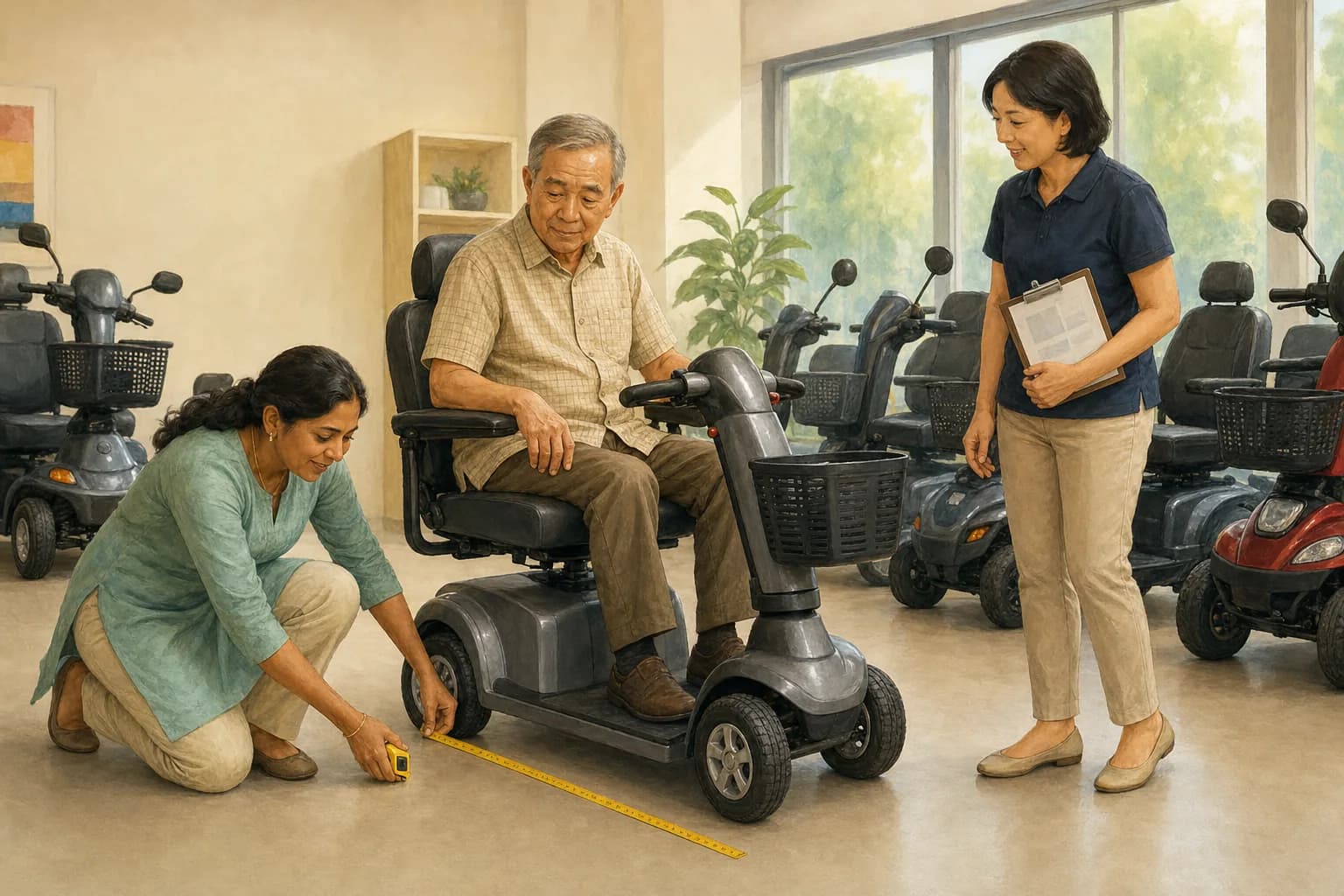
Will the scooter fit on a bus or train? A size check
The limits are 120cm long, 70cm wide, 150cm high and 300kg laden, and a device over any of them is barred from public paths as well as buses and trains. "Laden" is our reading of the scooter plus the rider and what they carry. Measure it yourself, with baskets and mirrors fitted.
An illustrative example (the family and both models are fictional; the limits are LTA's): Mr Lim, 74, weighs 68kg and carries about 8kg of shopping to and from the market.
- Scooter A: 116cm long, 62cm wide, 98cm high, 58kg. Laden weight: 58 + 68 + 8 = 134kg. Inside every limit.
- Scooter B: 124cm long with its rear basket, 66cm wide, 102cm high, 72kg. Laden weight 148kg is fine, but at 124cm it is 4cm over the length limit, so it is barred from public paths and public transport.
Mr Lim, at 74, needs no certificate. On our reading of the rule, his daughter, who is 45 and not exempt, may not ride it on a public path without a certificate of her own, even to fetch it for him.
A test ride and paperwork checklist
Our own checklist, built on LTA's rules:
- Settle the rider's status first: exemption by age or scheme, or a completed assessment showing on OneMotoring.
- Try it in the shop, not on the pavement, if the rider is not yet certified or exempt; a public path is where the rule applies. Check tight turns, the brakes, the seat height and whether the rider reaches the controls without leaning.
- Look for the Registration Mark and Identification Mark on the actual unit you will take home.
- Measure it and add up the laden weight.
- Ask how its speed is limited; on public paths it must not exceed 6km/h.
- Keep the receipt, the warranty card and a record of the ownership transfer. If the scooter turns out faulty, our Lemon Law action plan covers what to ask the seller for, and the Small Claims Tribunal checker shows whether a claim fits the tribunal's limits.
Can I buy a second-hand mobility scooter?
You can, but check more. LTA's registered-only rule is written for retailers. An unregistered scooter must be registered by 1 January 2029, after compliance checks on the device and the user by LTA's appointed vendor at the roving stations from mid-2027. Our sources do not say what those checks cover, so a used scooter bought today may fail them; ask for the brand and model name and keep the manual. From 2029 only retailers can register new scooters.
An existing device with a speed limit of up to 10km/h may stay in use until 31 December 2028, ridden at no more than 6km/h on public paths. Our hand-over test for second-hand electronics is a useful start for battery and charger checks.
What to do with an old scooter or e-scooter
NEA's e-waste recycling page lists ALBA's town council collection drives and its doorstep collection service (which charges a fee) as accepting electric mobility scooters, personal mobility devices and batteries, including standalone rechargeable ones. The last drives it lists run from 10am to 3pm on Saturday 31 October 2026 (Holland-Bukit Panjang and West Coast-Jurong West Town Councils) and Saturday 7 November 2026 (Ang Mo Kio and Jalan Kayu Town Councils); check ALBA's schedule for later ones. Never put batteries in general or blue recycling bins; tape the ends of rechargeable ones.
If the old device is actually a stand-up e-scooter without UL2272 certification, keeping it, at home or anywhere else, has been an offence since 1 June 2026; an individual faces a fine of up to S$2,000, up to three months' jail, or both for a first offence. See our e-waste recycling guide for other drop-offs, and the trying topic for more trial-first guides.
Common questions
Do seniors need a certificate to ride a mobility scooter in Singapore?
Not if they are 70 or older; LTA exempts them, although their exemption does not show on OneMotoring.
How fast can a mobility scooter go in Singapore?
No faster than 6km/h on public paths since 1 June 2026; existing devices with limits up to 10km/h may be used until 31 December 2028, still at 6km/h.
Can I take a mobility scooter on the MRT or a bus?
Only if it is within 120cm long, 70cm wide and 150cm high and no more than 300kg laden; a larger one is barred from public paths too.
Do I need to register a mobility scooter I already own?
Yes, if you use it on public paths, by 1 January 2029; LTA plans roving registration stations at community touchpoints from mid-2027.
Sources
- gov.sg's explainer gov.sg
- LTA's release on the new rules lta.gov.sg
- OneMotoring's mobility scooter page onemotoring.lta.gov.sg
- e-waste recycling page nea.gov.sg
Something changed or worth adding?
Send a correction or suggestion

