If you need an electrician in Singapore to add a power point, rewire a flat or deal with power trips, the Energy Market Authority (EMA) says the work should be done or supervised by a Licensed Electrical Worker (LEW); for an HDB flat, that is a licensed electrician. Check the licence card and look the person up on EMA's ELISE portal before work starts, expect new or moved wiring to be inspected by SP Services, and compare quotes on the same written scope. Rules as read on Friday 27 November 2026; we recommend no electrician, company or product.
At a glance
- LEW work: installing, repairing or changing wiring; adding, extending or replacing power points, switches and lighting points; repairing or replacing circuit breakers. Connecting a light fitting to an existing point is not, on an EMA engineer's rule of thumb.
- Which licence: a licensed electrician may work on installations up to 45 kVA at 1,000 V or below; EMA gives an HDB flat as electrician work.
- The check: an LEW's licence card shows a photograph, name, identity card number and licence number; verify it on ELISE or by calling 6835 8075, the number on EMA's safety page.
- Testing: new wiring, rewiring and extensions must be tested by an authorised officer from SP Services before supply is turned on; EMA says the LEW applies for the inspection.
- RCCB: all residential premises must have an RCCB or ELCB rated at no more than 30 mA; homeowners without one "may face a fine of up to $5,000 from 1 July 2025", EMA says.
- HDB permit: needed for a new 15 A point for an air-conditioner or other higher-capacity appliance in a flat without higher electrical loading.
When do you need a licensed electrical worker?
EMA's page on engaging licensed electrical workers says electrical work at home should be carried out or supervised by an LEW, and names three kinds: installing, repairing or modifying wiring; adding, extending or replacing power points such as socket-outlets, switches or lighting points; and repairing or replacing consumer control units or circuit breakers. Its electrical safety page defines electrical works as "any rewiring, modification/alteration, repair or replacement to the electrical installation", and adds that the LEW inspects and certifies the installation safe before the supply is turned on.
Where is the line? In a May 2025 feature, a principal engineer in EMA's Inspectorate Department offers a rule of thumb: you need an LEW if the work draws a new electrical connection from the circuit, while simply connecting an appliance such as a lighting fixture to an existing point does not need one. Shifting or extending a point does, and the LEW then applies to SP Services to inspect the finished work, "whether you are relocating a single power point or rewiring the entire home". HDB's home care guide to electrical accessories and wiring adds that only a licensed electrician can replace socket outlets.
An officer in the same feature says the water heater itself can be installed without an LEW, but you must engage one if the home has no dedicated connection point for it, and a water heater should never be plugged into a standard three-pin socket (see our water heater guide and appliance installation guide).
Which licence does a home electrician need?
EMA licenses three classes: a licensed electrician may work on installations up to 45 kVA at 1,000 V or below, a licensed electrical technician on installations up to 150 kVA for design or 500 kVA for operation, also at 1,000 V or below, and a licensed electrical engineer with no load limit, the voltage subject to licence conditions. EMA's own example is that electrical work in an HDB flat needs an electrician, while larger installations in a food court need a technician or even an engineer.
How do you check an electrician's licence?
EMA calls a valid licence "the most important thing to look out for". Every LEW is issued a licence card with a photograph, name, identity card number and licence number, and EMA asks you to verify the card before any electrical work begins. Its FAQ on verifying a licensed worker gives the route: on the ELISE portal, under "Search for Licensed Workers", choose "Electrical worker who offers services to consumers". The safety page also gives a phone number, 6835 8075.
EMA's May 2025 feature suggests asking the company in advance whether the person it sends is an LEW, and seeing the card on arrival. Our reading: a company name on a quotation is not a licence, so ask for the LEW's name and licence number on the quote and match them to the card on the day, the same first check our pest control guide suggests for a different trade.
What happens after the work is done?
EMA's safety page says new wiring, rewiring and extensions must be tested by an authorised officer from SP Services Ltd before supply can be turned on, and EMA's FAQ on rewiring says your appointed LEW will inspect and test the work to make sure it is safe before energising it. EMA's May 2025 feature says the LEW applies to SP Services for that inspection. Ask whether any inspection charge is in the quote; we could not open SP Group's pages on its process or charges.
In an HDB flat, the renovation guidelines for electrical works say a flat without higher electrical loading needs an HDB permit to install new 15 A power points for air-conditioners or other higher-capacity appliances. The page lists in tables the electrical works that need no HDB permit but remain subject to guidelines and conditions; those tables did not load in any copy we could read, so check them before assuming a job needs no permit. HDB's home care guide also advises replacing worn-out wiring.
Is an RCCB compulsory, and what if the power keeps tripping?
Yes. EMA's safety page says "all residential premises must have an RCCB or Earth Leakage Circuit Breaker (ELCB)", rated at a residual operating current not exceeding 30 mA under the Electricity (Electrical Installations) Regulations, and that "homeowners without an RCCB or ELCB installed in their premises may face a fine of up to $5,000 from 1 July 2025 as enforcement checks may be conducted randomly". EMA notes that HDB flats built before 1985 did not come with one unless an owner added it, and asks owners without one to have an LEW install it.
EMA's June 2026 feature on everyday habits asks homeowners to test the RCCB regularly, ideally once a month, in EMA's three steps: locate the RCCB in the distribution board and click the "test" button, so the switch flips down and cuts the power; check that the lights and power sockets no longer work; then switch off all lights and power sockets before flipping the RCCB switch back up. A circuit still powered with the switch down is not protected and should be inspected by an LEW. If the RCCB trips on its own, unplug a suspected appliance; if the tripping continues or the cause is unclear, an LEW should diagnose it. One officer also warns that buying circuit breakers or cables online for DIY replacement may pose safety risks.
The parts are regulated too. The Consumer Product Safety Office's list of controlled goods (last updated 23 June 2026) includes household 30 mA RCCBs, domestic wall switches and 13 A and 15 A socket-outlets, and its SAFETY Mark page (last updated 23 June 2026) says Controlled Goods must be tested and carry the SAFETY Mark before they can be sold. Our SAFETY Mark guide shows how to look one up.
Worked example: three quotes for three power points
Illustrative only: the firms, prices and items are invented, and the arithmetic is ours. A household wants three new 13 A power points in a study and asks three firms.
- Quote A: S$350 "for the job", no breakdown and no named electrician.
- Quote B: S$95 a point plus S$60 transport: 3 x 95 + 60 = S$345; names the LEW and licence number and says the LEW will apply for the SP Services inspection.
- Quote C: S$80 a point, a S$90 call-out fee and S$40 for testing paperwork: 3 x 80 + 90 + 40 = S$370; names the LEW.
On three points, B is S$5 below A and S$25 below C. If the household decides on the day to add two more points, A has to be requoted, B becomes 5 x 95 + 60 = S$535 and C becomes 5 x 80 + 90 + 40 = S$530, so C is now the cheaper named quote. The lesson of these invented numbers: compare quotes on the same written scope, ask for a price per point, and settle the licence question before the price. EMA's May 2025 feature encourages comparing quotations from a few LEWs on price and scope, and notes that cheaper contractors may have sent unlicensed workers. For a larger job, our renovation quote worksheet lays the comparison out line by line.
What should you ask before the electrician starts?
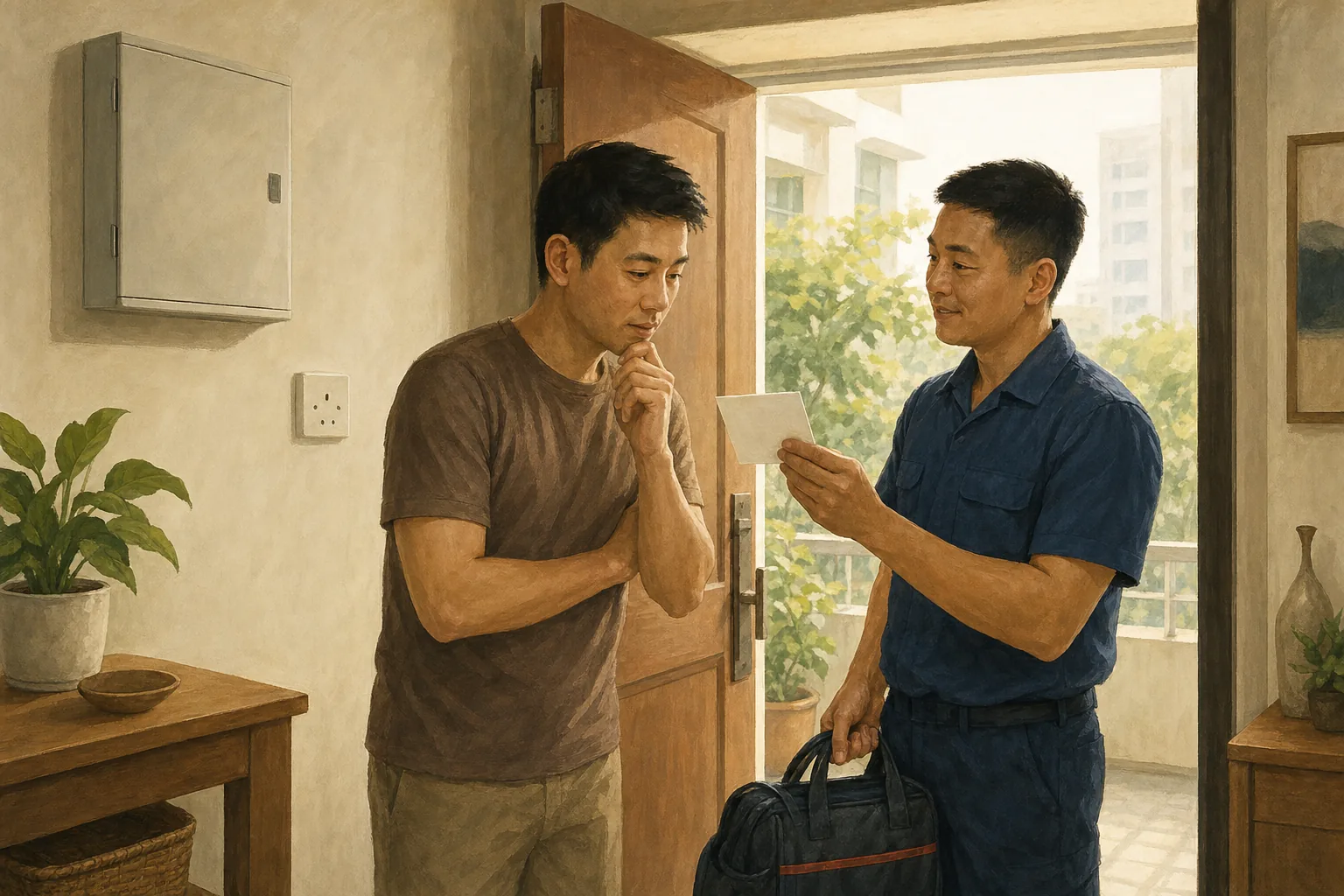
Our checklist, built from the pages above:
- Write down the job: which points, where, and whether anything is added or moved.
- Get the LEW's name and licence number on the quote, and look them up on ELISE.
- See the licence card on the day and match the photograph and number.
- Ask about the SP Services inspection: confirm the LEW will apply for it, when, and whether any charge is in the price.
- In an HDB flat, ask whether a permit is needed, for example for a new 15 A air-conditioner point in a flat without higher electrical loading.
- Ask for SAFETY-marked parts for any socket-outlet, switch or RCCB fitted.
- Keep the quote and receipt. If a dispute follows, see our Small Claims Tribunals guide and our other ownership guides.
Common questions
Do I need a licensed electrician to change a light fitting in Singapore?
Not to connect a light fitting to an existing point, according to an EMA engineer's rule of thumb; adding, extending, moving or replacing a lighting point, socket-outlet or switch is work for a Licensed Electrical Worker.
How do I check if an electrician is licensed in Singapore?
Ask to see the EMA licence card, which shows a photograph, name, identity card number and licence number, and look the person up on EMA's ELISE portal under "Electrical worker who offers services to consumers", or call 6835 8075, the number on EMA's safety page.
Is an RCCB compulsory in an HDB flat?
Yes: EMA says all residential premises must have an RCCB or ELCB rated at no more than 30 mA, and homeowners without one may face a fine of up to S$5,000 from 1 July 2025.
What should I do if my power keeps tripping?
Unplug the appliance you suspect and see whether the tripping stops; if it continues or the cause is unclear, EMA's officers advise engaging a Licensed Electrical Worker rather than troubleshooting or replacing breakers yourself.
Sources
- engaging licensed electrical workers ema.gov.sg
- electrical safety page ema.gov.sg
- May 2025 feature ema.gov.sg
- home care guide to electrical accessories and wiring hdb.gov.sg
- FAQ on verifying a licensed worker ema.gov.sg
- ELISE portal elise.ema.gov.sg
- FAQ on rewiring ema.gov.sg
- renovation guidelines for electrical works hdb.gov.sg
- June 2026 feature on everyday habits ema.gov.sg
- list of controlled goods consumerproductsafety.gov.sg
- SAFETY Mark page consumerproductsafety.gov.sg
Something changed or worth adding?
Send a correction or suggestion