
If you buy gold in Singapore, whether you pay GST depends on the form, not the shop. Investment-grade bars, wafers and certain bullion coins are exempt: gold of at least 99.5% purity from an accredited refiner, or a gold coin of that purity on IRAS's prescribed list. Jewellery, pendant bars with a hole, novelty shapes and proof coins are taxed at 9% when a GST-registered business sells them. Trading old jewellery in for new can cut the GST, but only if the shop applies IRAS's optional trade-in concession. Before Chinese New Year gifting, read the marks on the piece and ask for the right invoice before you pay.
At a glance
- 1 October 2012: investment precious metals (IPM) became exempt from GST, says IRAS's e-Tax Guide on the IPM exemption.
- 1 January 2024: GST rose from 8% to 9%, the rate on gold jewellery from a GST-registered seller.
- 1 January 2025: the trade-in concession for gold jewellery has applied only to customers who are not GST-registered, IRAS's Gold Jewellery page says.
- 30 January 2026: IRAS published the current IPM guide (20th edition) and GST and the Gold Jewellery Industry (7th edition).
- 6 and 7 February 2027: Chinese New Year public holidays, a Saturday and Sunday, on MOM's public holidays page.
Which gold is exempt from GST in Singapore?
IRAS's Supplies Exempt from GST page, last updated 14 August 2026, sets four tests for a bar, ingot or wafer, and it must pass all of them:
- Purity: gold of at least 99.5% (silver 99.9%, platinum 99%).
- Tradeable on the international bullion market: for gold, a refiner on the current or former Good Delivery list of the London Bullion Market Association (LBMA), or one endorsed by Enterprise Singapore. The page says no refiner currently holds that endorsement.
- A recognised quality mark, such as a Good Delivery refiner's hallmark. The IPM guide adds that bank-branded bars made by such a refiner qualify too.
- Not decorative or a collector's piece.
Coins must be gold of at least 99.5%, legal tender now or in the past in their country of origin, and on the list prescribed in the GST Act. IRAS's gold list includes the Singapore Lion (minted by The Singapore Mint), Canada Maple Leaf, China Panda, Malaysia Kijang Emas, Austria Philharmonic, Australia Lunar and United Kingdom Britannia; the IPM guide has the full list.
Which gold gifts are charged 9% GST?
Anything that fails a test is "non-IPM" and taxable, so a GST-registered seller charges 9%. IRAS's examples:
- Jewellery, whatever its purity.
- Bars with a hanger or hole for wearing as a pendant.
- Odd-shaped bars, such as boat, animal or heart shapes.
- Proof, numismatic and collector's coins, even versions of listed coins: the guide names Singapore Lion gold proof coins as an example.
- Bars from refiners not on the Good Delivery list, and scrap gold.
A design is not automatically disqualifying. IRAS's own example in the IPM guide is the PAMP Suisse Lunar Series bar, featuring a Chinese zodiac animal, which qualifies because it is traded and priced on its metal content, not its design. We cite IRAS's example and endorse no brand. A bar cut into an animal's shape does not qualify.
A wearable gift can keep the exemption. In the jewellery guide's FAQ, IRAS says an IPM wafer framed into a pendant at the buyer's request still qualifies, and GST is charged only on the frame, provided the wafer's form is unchanged and the wafer and frame are itemised separately on the invoice.
How is GST worked out when you trade in old gold jewellery?
Normally the shop charges GST on the full value of the new piece and your old piece is a separate sale. For old gold jewellery traded in for new, IRAS lets a GST-registered jeweller charge GST on the difference instead, if the customer is not GST-registered:
- It is optional. Jewellers do not have to apply it, and those who cannot tell whether a customer is GST-registered cannot.
- It does not cover gold bars, IPM or not, or loose and scrap gold.
- Workmanship counts. The difference is worked out on the new piece including workmanship. If your old piece is worth more, there is no GST on the gold, only on the workmanship fee.
Worked example: a Chinese New Year gold errand
The family is invented; the trade-in figures are IRAS's own example, and the comparison without the concession is our arithmetic.
Mdm Lim, not GST-registered, trades in an old chain valued at S$1,200 for a necklace valued at S$1,500 before GST, including S$30 workmanship.
- With the concession: GST is 9% of the S$300 difference, S$27, so she pays S$327, as IRAS's table shows.
- Without it: on our reading of the normal rule, GST is S$135 on the full S$1,500, the bill is S$1,635, and the S$1,200 chain is set against it, leaving S$435. That is S$108 more, 9% of the chain's value.
IRAS also shows a receipt layout jewellers should not use for such a customer, listing S$108 of "GST @ 9% on old gold". The correct one shows the new piece, less the old piece, then 9% on the difference.
For her grandson's gift, our illustrative figures, not shop prices: if two 5g pieces carry the same S$1,000 gold price, a qualifying bar costs S$1,000 with no GST, while a pendant-bar with a hole from a GST-registered shop costs S$1,090. A qualifying wafer framed as a pendant attracts GST only on the frame: a frame priced at S$109 including GST carries S$9 of it, using the 9/109 tax fraction IRAS applies to GST-inclusive amounts.
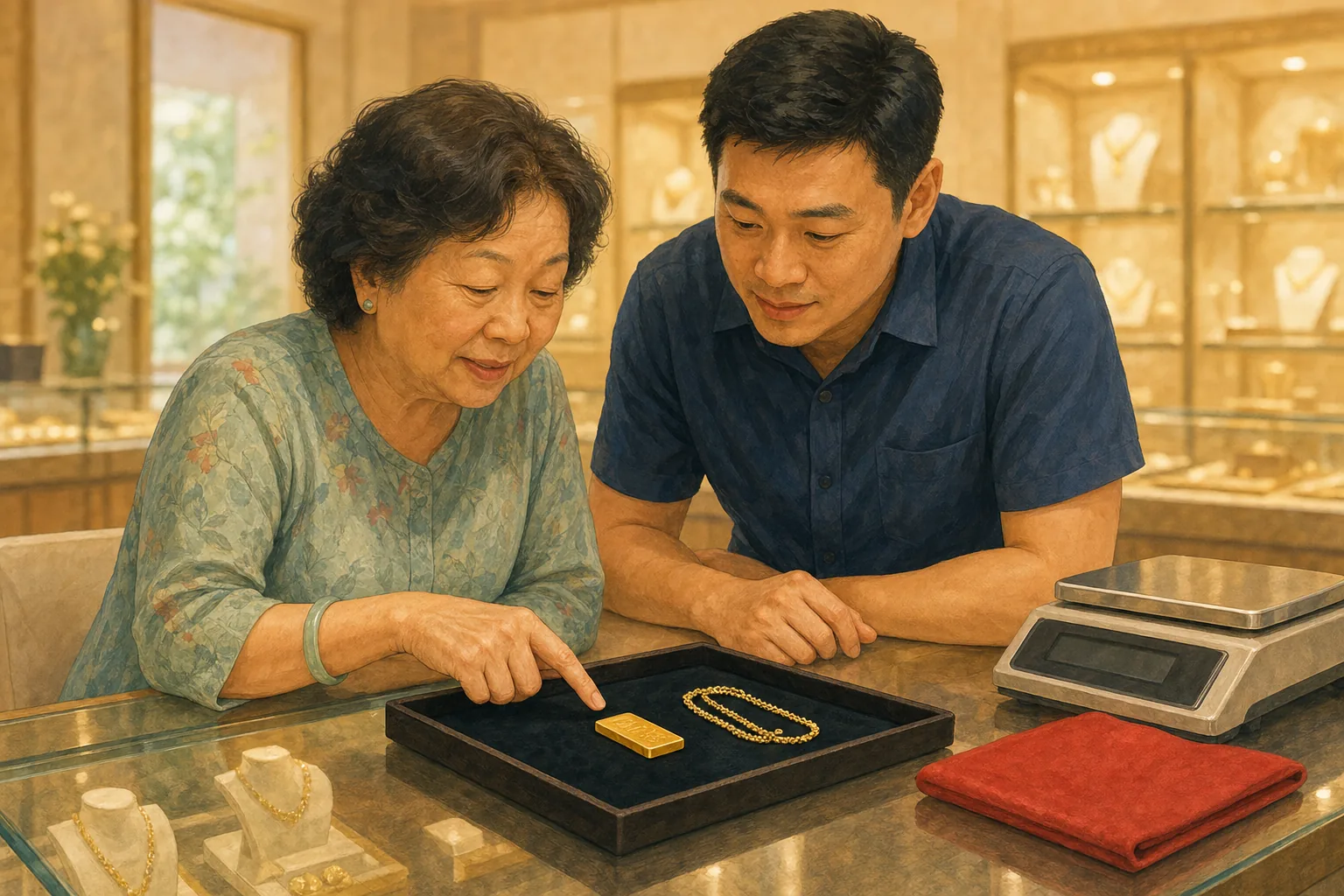
A checklist before you pay for gold
- Read the surface. The IPM guide says a bar typically shows the refiner's name or hallmark, its purity and the metal. No refiner mark, purity under 99.5% or a hole for a chain means it is not IPM, and a GST-registered seller charges GST.
- Check the refiner against the LBMA's current or former Good Delivery list, which IRAS points to; we did not open it, so ask the dealer to show you.
- Check coins against IRAS's list, and treat proof, numismatic and collector's versions as taxable, as IRAS does.
- Ask for an IPM invoice. For an exempt sale IRAS requires a separate invoice naming the supplier and its registration number, your name and address, and for each bar the metal, weight, purity, refiner, serial number (where applicable) and unit price.
- Get the GST-inclusive price. IRAS's page on buying from a GST-registered business says registered businesses must not quote prices without GST ("$100 + GST" is not acceptable), and only they may charge GST.
- Ask whether the trade-in concession applies, and check the receipt layout.
- Keep deposit receipts. For a custom order, the jewellery guide says GST is accounted for on a deposit that forms part payment when it is received.
- Compare price per gram for pieces of the same purity with our unit price calculator (price per 100g divided by 100), and keep weight, purity and workmanship in writing, as in our checkout records guide.
What this guide does not settle
This covers tax and paperwork, not whether gold is a good investment, and is not investment advice; we checked no shop's prices or buy-back rates, and not the Ministry of Law's rules for precious metals dealers. For gold bought abroad, the IPM guide says importing IPM is also exempt; for other goods, see our GST relief guide for travellers. Singapore Customs' page on importing IPM did not open for us. If a clasp fails soon after purchase, see our Lemon Law action plan; more checks are in our comparing topic.
Common questions
Is there GST on gold in Singapore?
Not on investment-grade bars, wafers and prescribed coins that pass IRAS's tests; gold jewellery, pendant bars, odd-shaped bars and proof coins are taxed at 9% when sold by a GST-registered business.
Is a Chinese zodiac gold bar exempt from GST?
It can be: IRAS's own example, the PAMP Suisse Lunar Series bar with a zodiac design, qualifies, but a bar shaped like an animal, or one with a hole for a chain, does not.
Do I pay GST when I trade in old gold jewellery?
If you are not GST-registered and the jeweller applies IRAS's optional concession, only on the difference between the new piece (including workmanship) and the old one; otherwise on the full value of the new piece.
Can I turn an investment wafer into a pendant without paying GST on the gold?
Yes, IRAS says the wafer stays exempt and only the frame is taxed, as long as the wafer's form is unchanged and the two are itemised separately on the invoice.
Sources
- e-Tax Guide on the IPM exemption iras.gov.sg
- Gold Jewellery page iras.gov.sg
- GST and the Gold Jewellery Industry iras.gov.sg
- public holidays page mom.gov.sg
- Supplies Exempt from GST page iras.gov.sg
- buying from a GST-registered business iras.gov.sg
Something changed or worth adding?
Send a correction or suggestion

